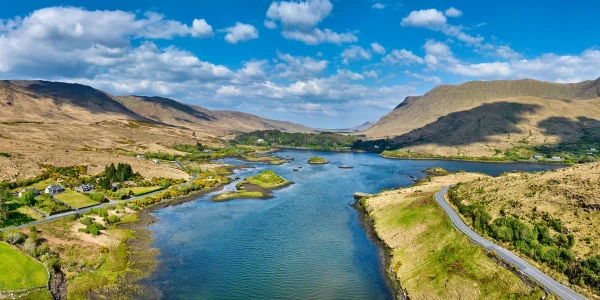
Deep beneath the lush green fields of western Ireland, one of the world's largest underground river systems pulses through limestone caves and springs, shaping the landscape above. This hidden hydrological network, newly recognized as part of the UNESCO-designated Joyce Country and Western Lakes Geopark, powers the region's geography much like a subway system drives a city.
“If you take all these springs together in terms of flow, it's by far the largest in Ireland, and one of the biggest systems in the world,” said Dr. Benjamin Thébaudeau, the geopark's geologist.
The area's dramatic terrain—where rivers vanish into fissures and roads wind through glacial valleys—also captivated Hollywood. In 1952, John Ford filmed The Quiet Man in the village of Cong, perched between Lough Mask and Lough Corrib. The village's name derives from the Irish word for “narrows,” reflecting its water-bound geography and the invisible springs that surface around it.
At the Quiet Man Museum, curator Lisa Collins notes that honeymooners still arrive dressed as John Wayne and Maureen O'Hara characters. The museum, recognized as a Treasure of European Film Culture, plans to celebrate the film's 75th anniversary next year. Among the exhibits is a fishing rod used by the village priest in a famous scene where Mary Kate, speaking Irish, hints at marital tensions—a coded exchange that slipped past 1950s censors.
But the geopark's character comes not only from its karst terrain and cinematic fame. It lies at the heart of a living Gaeltacht, where Irish is spoken daily, in place names and at Burke's Bar in nearby Clonbur. The language, like the underground rivers, runs beneath the surface of everyday life.
History also layers the land. The Augustinian abbey at Cong, founded under Gaelic royal patronage and later rebuilt by Normans, was where the last high king of Ireland, Rory O'Connor, spent his final years. Centuries later, the Guinness family transformed Ashford Castle into a Victorian hunting lodge. Nearby, the ruins of Moore Hall, once a rare Catholic-owned estate, stand half-collapsed after the Civil War, slowly reclaimed by forest.
Just outside Cong, the Pigeon Hole cave system offers a glimpse into the subterranean world. Its entrance descends into a narrow chasm where an underground river flows in darkness. Here, legend speaks of the White Trout of Cong—a woman transformed into a pale fish after her lover's murder. Thébaudeau notes that fish living in sunless caves can lose pigmentation, lending a grain of truth to the myth.
Yet modern pressures threaten this watery realm. A salmon hatchery near Ashford Castle struggles to sustain declining wild populations. “Maybe we are fighting a losing battle,” Thébaudeau admits, citing climate change, warming seas, and stressed river systems. Trout, which stay in local lakes, fare better.
From the liquid darkness of caves to the silver screen, Joyce Country's waters connect geology, myth, and memory—a landscape where stories and streams both run deep.