Skip to main contentSkip to navigation
Close dialogue 1/4 Next image Previous image Toggle caption
Support the Guardian
Fund independent journalism
Support from $3.45 a weekSupport from $3.45 a week
US
The Guardian - Back to home The Guardian
- [x]
Show more Hide expanded menu
-
- News
-
- Opinion
-
- Sport
-
- Culture
-
- Lifestyle
-
Search input google-search Search
-
* [Search jobs](https://jobs.theguardian.com/) -
Search input google-search Search
- [x]
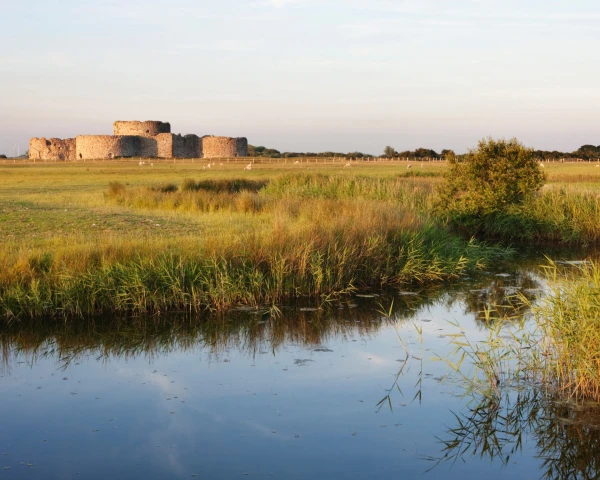
Camber Castle, where the author took a detour en route to Rye. Photograph: Noble Images/Alamy
Camber Castle, where the author took a detour en route to Rye. Photograph: Noble Images/Alamy
‘The landscape offers the same russet and ochre hues as the Bayeux tapestry’: walking the 1066 trail in East Sussex
With the British Museum’s blockbuster Bayeux tapestry exhibition opening soon, we follow in the footsteps of William the Conqueror and King Harold’s armies around Battle and Rye
Pamela Petro
Wed 1 Jul 2026 02.00 EDT Last modified on Wed 1 Jul 2026 03.25 EDT
Share
‘U h oh, look at these!” I call to my friends, Annie and Mike. “Ominous,” remarks Annie. Mike raises an eyebrow. We’re hiking the Pevensey Levels, marshland first drained in 772, home now to sheep and cattle, but also water spiders, living underwater in air-filled webs. The ground is pocked with endless impressions of horseshoes.
“It’s almost as if an army came this way,” I say.
And we laugh, but only because we missed that army by 959 years. Annie, Mike, Fflos the dog, and I are on our first day of following the 1066 Country Walk across East Sussex, beginning at Pevensey, ending in Rye. At the midpoint is the town of Battle, where we have rented an outbuilding conversion for three nights. Battle is known as the probable site of the Battle of Hastings: the brutal killing field where about 2,000 Normans, 4,000 Anglo-Saxons and 700 horses died one day in October 1066, according to various sources, leading to William the Conqueror defeating King Harold for the crown of England.
Battle Abbey. Photograph: Maciej Olszewski/Alamy
History commands an immediacy outdoors that it doesn’t in books. You ask different questions on foot. We were on the Levels at the same time of year, September, as the Normans: did they note the blackthorn heavy with sloes? Spot blackbirds feasting on blood-red hawthorn berries? Hear the wind in the rushes alongside the River Pevensey? Did they remark how faded yet abundant this land was on the cusp of autumn? Doubtful, but the contradictions of war-making in such a gentle place – gentle light, gentle breeze, birdsong and river currents – make an impression on us. We notice how the landscape offers the same russet, sage and ochre hues as the Bayeux tapestry.
With each shift of scene comes a hurtling from present to past and back again. The effect is of a temporal quilt sewn with our footsteps
The 1066 Walk covers 31 miles, and we’ve given it four days: Pevensey to Herstmonceux, 6 miles; Herstmonceux to Battle, 11; Battle to Icklesham, 9; and Icklesham to Rye, 5. Our second day is the longest and steepest, and yet my favourite, as it establishes a pattern that continues throughout. We pick up the well-signposted route in the green secrecy of Wartling Wood, carpeted in acorns, lined by blackberries, and follow it around sunny fields. We emerge into the neat village of Boreham Street, plunge down a holloway guarded by beeches, and roll out into more fields with windswept, distant horizons. The impression is of a settled, well-inhabited landscape – a feeling augmented by morning tea at the Ash Tree Inn in the hamlet of Brownbread Street – but another deeper, more enduring impression underlies it.
Perhaps because the route is designed to call the distant past to mind, with every shift of scene we experience a slippage of time. One moment we’re walking down a contemporary street being passed by speeding cars, then we slip through a small opening in a hedge and plunge not only into fields or woods, but out of the present into time immemorial. There’s a constant weaving in and out of darkness and light, wildness and cultivation, close-grown tunnels of greenery and wide-open, windy spaces, and with each shift comes a hurtling from present to past and back again. The effect is of a temporal quilt sewn with our own footsteps. We encounter few other walkers to break the spell.
Colour saturated … St Thomas church in Winchelsea. Photograph: Nelson Art/Alamy
Elasticity of time is most apparent on Tent Hill, where, as Mike puts it, “the reward to effort ratio is quite good”. Sources suggest one army or the other – no one knows which – camped here, hence the name. Instead of troops, we discover an ancient horse chestnut with branches so immense they have touched the ground and put down roots of their own, creating a family of trees around a living, central ancestor. Joining their company is occupying past and present at once.
We have traversed apple orchards and spent the morning in mellowness reminiscent of Dutch landscape paintings
Because Mike has had the good sense to rent accommodation at Abbey View Cottages – there is indeed a view of Battle Abbey’s towers – we set forth on day three from our own digs. Another plunge off a country lane lands us on a bridle path in Battle’s Great Wood, where Mike announces: “My fungi sense is twitching.” Soon he is giving a mushroom tutorial: fly agarics; edible boletes and parasols; great penny buns (“the Rolls-Royce of mushrooms,” Mike pronounces).
And then the temporal hopscotch continues. One minute we’re crossing a golf course, the next we’re in deep countryside with venerable oasthouses tucked into hill folds. Shortly before arriving at the welcoming Three Oaks pub, we come upon one of artist Keith Pettit’s 10 Bayeux tapestry-inspired sculptures on the route: six hollow, Celtic-carved oak pillars planted inside with hawthorn. Together they form a circle of growing, living wonder on a hillcrest.
skip past newsletter promotion
Free newsletter | Twice a week
Sign up to The Traveller
Get travel inspiration, featured trips and local tips for your next break, as well as the latest deals from Guardian Holidays
Enter your email
Sign up
after newsletter promotion
Rye: ‘A town of Henry James, antique shops and good food’. Photograph: Jenifoto/Getty Images
Our final hike brings us to medieval Winchelsea, rebuilt by Edward I in the 1280s after the original town was washed away. We have traversed apple orchards and spent the morning in mellowness reminiscent of Dutch landscape paintings. To our joy, the modern stained glass windows of Winchlesea’s St Thomas church, created byDouglas Strachan as memorials following the first world war, bloom on the route like colour-saturated rainbows.
From Winchelsea, we head to Rye across the silted-in, coastal lowland that would have been underwater in Edward’s day. With Rye in eyeshot, we depart from the official 1066 Country Walk to detour past the ruin of Camber Castle, pressed into the flatland by a big, heavy sky. Begun in 1512, finished in 1544 and demolished in the 1640s by parliamentary forces in the English civil war, it’s a reminder of vulnerability – the waves and threats of invasions this coast has seen – and hubris, simultaneously.
With a final shift of perspective – pastureland to townscape – we fetch up in pretty, comfortable Rye, town of Henry James, antique shops and good food. We are more energised than exhausted, and grateful we didn’t have to conquer this place with anything more than our imaginations.
The Bayeux tapestry is on display at the British Museum from 10 September to 11 July 2 027 ’ tickets now on sale . Abbey View Cottages sleeps four, from £200 a night; rooms as the Ship Innin Rye from £75 .
Pamela Petro is the author of The Long Field , published by Little Toller (£14). To support the Guardian buy a copy at guardianbookshop.com. Delivery charges may apply .
At this dangerous time
We hope you appreciated this article. Before you close this tab, we want to ask if you could support the Guardian at this dangerous time for journalism in the US.
According to a leading global watchdog, American democracy is now more imperiled than at any point since the 1960s, marked by a precipitous decline in press freedom – driven by mounting pressure from the Trump administration in the form of threats, criminal investigations, politicized regulation, frivolous lawsuits and, for public media, catastrophic funding cuts.
Meanwhile, organizations that are supposed to be independent like the FBI and the FCC, our radio and television regulator, have also been targeting press freedom under Trump-aligned leadership, with the FBI raiding a reporter’s home and the FCC threatening ABC’s TV licenses after Jimmy Kimmel made a joke about Melania Trump.
The response from some ultra-wealthy and corporate media owners, keen to appease the president, has been chilling: CBS News has been taken over by a Trump ally; CNN is poised to be taken over by the same billionaire; Jeff Bezos has continued to impose cuts and editorial interventions at the Washington Post; and multiple outlets have settled multimillion-dollar lawsuits from the administration to protect their business interests.
Democracy is best served by a robust, thriving free press. But when that freedom is under attack, it falls to a determined few news organizations to ensure the full truth still reaches the public. Owned neither by a billionaire nor a corporation, the Guardian remains dedicated to covering this administration with uncompromising moral and factual clarity – and to keeping trustworthy journalism paywall-free for the world.
Despite the risks of maintaining our fierce independence, what sustains us – and fills us with deep gratitude – is the unwavering support we’ve seen from readers. It is no exaggeration to say that we are here because of you: a majority of our funding comes directly from people like you responding to messages like this. Your support not only powers our work, but more importantly, it safeguards the financial independence that underpins our editorial freedom and courage.
We know our requests for support are not as welcome as our reporting, but without them, it’s simple: our reporting wouldn’t exist. Of course, we understand that some readers are not in a position to support us, and if that is you, we value your readership no less.
But if you are able, please support us today. All gifts are gratefully received, but a recurring contribution is most impactful, helping sustain our work throughout the year ahead (and among the great benefits, we’ll show you far fewer fundraising requests like this). It takes just 37 seconds to give. Thank you for protecting the free press.
Support $1.15/week
Recommended
Support $3.45/week
UnlockAll-access digitalbenefits:
- Far fewer asks for support
- Ad-free reading on all your devices
- Unlimited access to the premium Guardian app
- Regular dispatches from the newsroom to see the impact of your support
- Unlimited access to Feast, the Guardian recipe app
Support once from just $1
Remind me in August
Explore more on these topics
Share
Most viewed
- #### Democratic socialist Melat Kiros defeats 15-term incumbent in Colorado House primary
- #### Why Meloni has hit back hard against Trump and his ‘made up’ photo claim Riccardo Alcaro
- #### The eternal whirring of the Caitlin Clark conspiracy machine has shifted into a new gear
- #### Click bait! Kraszna-Krausz photography book award winners – in pictures
- #### R&B star Chris Brown ordered to pay $13m to housekeeper mauled by his dog
Related stories
Related stories
- ### Art trails, swimming spots and punt safaris, all easily accessible from Cambridge’s new train station 6d ago19 19 comments
- ### In the footsteps of a Welsh borderlands baddie: walking the Mortimer Trail 19 Feb 2026
- ### Hiking Cheshire’s Baker Way: the joy of a less-known walking trail 8 Oct 2024
- ### Walking through the Yorkshire Wolds to a great village pub: the Goodmanham Arms 12 Feb 2024
- ### Car-free tour of East Sussex: waterside walks, woods and delicious food stops 11 Jan 2024
- ### The wonder of Wessex: walking the Ridgeway in Wiltshire and Oxfordshire 19 Jul 2023
- ### Calderdale: a hike in Yorkshire’s Happy Valley 2 Feb 2023
- ### Walking Pendle Hill’s new trail: the Two Toms 25 Aug 2022
More from Lifestyle
More from Lifestyle
- ### Jess Cartner-Morley on fashion: still wearing stripes? It’s time to join the dots 29m ago1 1 comments
- ### A moment that changed me: my grandpa risks his life to litter pick – and he taught me a profound lesson 8h ago
- ### Women behind the lens: ‘My grandma dressed like a celebrity, even matching the colour of her cigarettes to her outfits’ 8h ago
- ### Cue the fireworks: the 13 best early Fourth of July sales we found from Home Depot, REI and more 18h ago
- ### Seven ways to get the most out of a window air conditioner during extreme heat in the US 19h ago
- ### The pie floater: it’s all gravy, upside down 20h ago
- ### I pushed myself too hard at the gym – and ended up in the hospital 22h ago
- ### Hospitality VAT cut: can it help the sector and at what cost to UK taxpayer? 1d ago
Comments (12)
Sign in or create your Guardian account to join the discussion
Comments (12)
Sign in or create your Guardian account to join the discussion
Guardian Pick
I walked this last August- taking two days with an overnight break in Battle. Very enjoyable, with plenty of variety. Highly recommended.
Any suggestions for walks of a similar length, much appreciated.
2
Guardian Pick
The walk from Pevensey to Rye is extremely pleasant, especially as it avoids the tackiness of Hastings by going through Battle. I wonder though if anyone noted the interesting drowned forest on Pett Level beach, where you can see hundreds of tree stumps at low tide, probably dating back to the last ice age.
The Norman invasion changed Britain politically, socially and economically, and was executed with brutal thoroughness, and the count…
2
Guardian Pick
I walked this last August- taking two days with an overnight break in Battle. Very enjoyable, with plenty of variety. Highly recommended.
Any suggestions for walks of a similar length, much appreciated.
2
Guardian Pick
The walk from Pevensey to Rye is extremely pleasant, especially as it avoids the tackiness of Hastings by going through Battle. I wonder though if anyone noted the interesting drowned forest on Pett Level beach, where you can see hundreds of tree stumps at low tide, probably dating back to the last ice age.
The Norman invasion changed Britain politically, socially and economically, and was executed with brutal thoroughness, and the count…
2
View more comments
Most viewed
Most viewed
Most viewed Across the Guardian
-
Democratic socialist Melat Kiros defeats 15-term incumbent in Colorado House primary
-
Why Meloni has hit back hard against Trump and his ‘made up’ photo claim
-
The eternal whirring of the Caitlin Clark conspiracy machine has shifted into a new gear
-
Click bait! Kraszna-Krausz photography book award winners – in pictures
-
R&B star Chris Brown ordered to pay $13m to housekeeper mauled by his dog
-
ICE releases Texas nun intercepted walking to church dressed in her habit
-
Death by firing squad: archaic method on the rise in US as Idaho opens new execution chamber
-
A moment that changed me: my grandpa risks his life to litter pick – and he taught me a profound lesson
-
US man dies while discarding body of girlfriend he fatally strangled, officials say
-
Call to suspend new EU border system in peak holiday period as planes leave half full
Most viewed in Travel
-
Six of the best long-distance European trails to walk in summer
-
‘The landscape offers the same russet and ochre hues as the Bayeux tapestry’: walking the 1066 trail in East Sussex
-
Incredible panoramas, wildflower meadows and the odd wild horse: readers’ favourite walks in Europe
-
Trekking through a living mountain culture: Spain’s Picos de Europa
-
‘Hearty fare, red gingham tablecloths and chalkboard menus’: my search for the perfect bouchon in Lyon
-
Limerick: the not-so-gritty city is one of Ireland’s overlooked gems
-
50 songs for 50 states
-
Giant underwater ‘jellyfish’ roundabout becomes latest Faroe Islands tourist attraction This article is more than 5 years old
-
Changes to Been there readers' tips and photo competitions
-
A break from the accommodation mega-sites: the best alternative booking platforms
Original reporting and incisive analysis, direct from the Guardian every morning
-
California resident – Do Not Sell or Share
Support the Guardian
Available for everyone, funded by readers
© 2026 Guardian News & Media Limited or its affiliated companies. All rights reserved.(dcr)