The lollipop people crisis: what does the road rage against them say about Britain today? | Social etiquette | The Guardian
Skip to main contentSkip to navigation
Close dialogue 1/5 Next image Previous image Toggle caption
Support the Guardian
Fund independent journalism
Support from $3.45 a weekSupport from $3.45 a week
US
The Guardian - Back to home The Guardian
- [x]
Show more Hide expanded menu
-
- News
-
- Opinion
-
- Sport
-
- Culture
-
- Lifestyle
-
Search input google-search Search
-
* [Search jobs](https://jobs.theguardian.com/) -
Search input google-search Search
- [x]
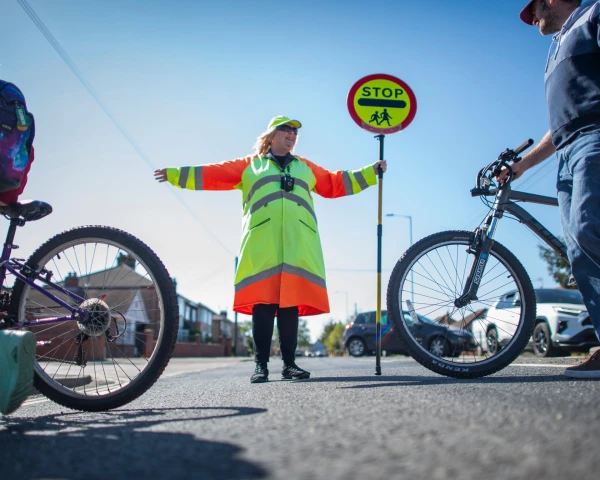
‘It’s really scary’ … Lynne Gorrara helps people across Foxhall Road in Ipswich. Photograph: Joshua Bright/The Guardian
‘It’s really scary’ … Lynne Gorrara helps people across Foxhall Road in Ipswich. Photograph: Joshua Bright/The Guardian
The lollipop people crisis: what does the road rage against them say about Britain today?
They just want to help children safely across the road on their way to and from school. Yet lollipop people are having to wear body cameras after an increase in abusive and dangerous drivers. How did things get so out of hand?
Wed 13 May 2026 04.45 EDT First published on Wed 13 May 2026 00.00 EDT
Share
T here aren’t many jobs that often involve jumping out of the path of speeding cars– but for the lollipop people of Britain today, this is the sad reality. And it doesn’t stop there: aggression, swearing and middle fingers are just a few examples of the intimidation and abuse they face on our roads.
“Oh my God, I mean, abuse of lollipop people? What has the world come to?” says Lynne Gorrara. It’s a crisp, sunny afternoon in Ipswich and the 61-year-old is holding a towering stop sign above her head, clearing a crossing for a stream of schoolchildren. This spot – on a narrow residential road, with a hospital in one direction and shops in the other – is notorious for abusive drivers.
It’s hard to miss Gorrara and her colleagues, because, as she says, they are “lit up like a Christmas tree” in their neon jackets. Unfortunately, this makes no difference. Motorists have, on occasion, hurtled towards them at 50mph, some even waving as they pass. Of course, the lollipop people are not the only ones in danger. “It’s really scary, because you’re constantly watching the children– that’s my priority,” says Gorrara. “When you know they’re not going to stop, you’ve got to make sure you’ve got everybody else out of the way, too.”
To combat the epidemic of abuse, Suffolk county council has given lollipop people body-worn cameras to record drivers behaving badly. “We know that it’s a national problem. It’s not just happening in Ipswich,” says Mike Brooks, the council’s safer active travel manager. According to the most recent Home Office data available, for 2024, more than 3.5m motoring offences were recorded by police in England and Wales – the highest figure since records began. Meanwhile, the Telegraph reported in 2024 that, based on freedom of information requests, the number of crimes committed in the UK that mentioned “road rage” or “aggressive driving” in police logs had shot up by 34% in three years.
‘I just love it, because it gives me a reason to get up in the morning and get out of the house’ … Gorrara on patrol. Photograph: Joshua Bright/The Guardian
Some times of the year are worse than others. On a sunny day like today, drivers are in a chipper mood. But Gorrara and her colleagues dread what should be one of the happiest seasons: Christmas. “The volume of traffic is even higher and people get impatient,” she says. Despite the abuse, she loves the job, which she has been doing for 10 years. “It’s not for the money or the uniform,” but for the joy of serving her community and seeing the schoolchildren grow up. “You’ll see them in high school jumpers and think: oh my goodness!”
Alongside Gorrara is Michelle Whinney, who has been a lollipop person in the county for 12 years. The 57-year-old says things have got worse “in the last four to five years” and she has seen drivers “punching their steering wheels and sticking their fingers up” at her. She, too, has had to dodge oncoming cars. “They can be quite rude at times and there’s no need at all. We only stop you for a second.” As well as what seems to be a rising tide of anger in society, Whinney blames “more cars on the road” (there were 42m vehicles on Britain’s roads in 2025, a rise of more than 5m in a decade).
There is also a problem with drivers not understanding the role of lollipop people. Suffolk county council has fitted the body-worn cameras as part of a campaign called Lollipops Aren’t Just for Children to make motorists aware that lollipop people “can legally stop traffic for anybody”, says Brooks. He says this lack of understanding is often the source of abuse. “It usually takes the form of a driver saying: ‘You shouldn’t be stopping me, because there are no children here – there’s only adults.’”
We know that it’s a national problem. It’s not just happening in Ipswich
Among the adults being guided across the road today is Abby Hart, 40, who has just picked up her kids from the nearby primary school. “They’re phenomenal,” she says of Gorrara and Whinney. “So kind, friendly and good with the kids.” Hart says she has seen some “close encounters” first-hand where cars weren’t willing to stop. “It’s a bit sad. No one’s in that much of a rush, surely?” Her children are approaching the age where they will be able to walk to school alone. “Knowing there’s someone here to help the kids safely cross just makes sense.”
Suffolk isn’t the only council trialling body-worn cameras for lollipop people: they are also being used in Greater Manchester, as well as Clacton and Basildon in Essex. Brooks says several other councils are looking to Suffolk for inspiration, including some in London, where low-traffic neighbourhoods, which close residential roads to cars, have provoked vicious rows between motorists and local authorities.
Some of the footage captured by the body-worn cameras has led to action by the police, with officers having a stern word with abusive drivers or handing out fines. “Nobody should go to work and receive abuse. Unfortunately, our patrols have got into the frame of mind that it is normal, and that’s wrong,” says Brooks.
‘They’re phenomenal – so kind, friendly and good with the kids’ … local parent Abby Hart. Photograph: Joshua Bright/The Guardian
Gorrara and Whinney work with a crossing patrol manager, Andy Patmore. The 58-year-old says lollipop people bring joy to pedestrians, especially when they embrace their crossing as “an extension of their personality”, but he warns they are in the same boat as other people policing our roads, including parking wardens, who report enduring physical violence, verbal threats and sexual assault. During one shift with Gorrara, lasting about 30 or 40 minutes, he says that seven cars tried to drive though them.
He has a message for drivers taking out their frustrations on his team: “Please don’t. We’re human beings as well. You’re not going to shout at a traffic light, but you can shout at one of us. It hurts our feelings and gets us down.”
The stream of schoolchildren peters out and the team lower their stop signs. Their shift is over. Despite the threats, Gorrara is excited to return tomorrow. “I just love it, because it gives me a reason to get up in the morning and get out of the house. I recently lost my husband, so it’s given me even more of a purpose to serve my community.”
Lollipop people have helped pedestrians across Britain’s roads for almost 90 years. In 1937, Mary Hunt, a school caretaker, became the country’s first lollipop person, guiding schoolchildren to safety in Bath. “She absolutely loved it,” says her grandson, Colin Hunt. His grandmother was “not much more than 5ft tall”, he says; she told him the first sign they gave her was so big that “she would go sailing off down the road” when hit by a gust of wind.
‘Nobody should go to work and receive abuse’ … Michelle Whinney (left) and Gorrara with their supervisor, Andy Patmore. Photograph: Joshua Bright/The Guardian
Hunt’s appointment was announced in the Bath Chronicle in September 1937 with the warning that drivers who “flash by when she is seeing her youthful charges across the road will have their numbers taken, and if an offence has been committed, will be summoned”. She patrolled the roads of Bath for nearly 25 years. Colin Hunt says abuse occured even then, including from “speeding vehicles that just wouldn’t stop”.
After the second world war, several councils in east London followed Bath’s lead and appointed their own “able-bodied pensioners” as lollipop people. The idea soon spread across the country. But, at the turn of the millennium, things changed. With the passage of the Transport Act 2000, councils were no longer legally obliged to appoint lollipop people. This – and later the government’s austerity policies – resulted in their numbers decreasing. The Mirror reported last year that councils were employing half as many lollipop people as in 2014, and many local authorities are axing them entirely. Durham county council, which has been controlled by Reform UK since May 2025, has proposed a hiring freeze on lollipop people as part of an Elon-Musk-inspired “Department of Government Efficiency” audit to eliminate “wasteful spending”.
No kidding … lollipop people can legally stop traffic for anyone, regardless of their age. Photograph: Joshua Bright/The Guardian
And yet, while the number of lollipop people has fallen, the risks to children on the roads have increased. The number of under-16s killed or seriously injured has risen by 17% in England, jumping from an average of 1,884 between 2017 and 2019 to an average of 2,204 between 2022 and 2024, according to the Department for Transport. “Children are important and lollipop people take their lives into their hands to make sure they’re kept safe,” says Hunt. While bad behaviour has always been an issue, including in his grandmother’s day, he says it is an “absolute tragedy” that lollipop people have had to resort to wearing cameras.
Josh Cohen, a psychoanalyst and the author of All the Rage: Why Anger Drives the World, says anger on the roads is “about the link between rage and humiliation”, with road rage incidents marking “mini, momentary power struggles … where people use the road to try to exert power over the other person”.
Social media can help fuel this, he says, by “feeding us a constant stream of provocations”, and creating scapegoats. “It’s quite easy to imagine a scenario where lollipop people become public enemies on social media by impeding the flow of traffic.”
For anyone in doubt, Gorrara emphasises that lollipop people are nothing to fear. “We’re not out to get anyone,” she says. “We just want you to slow down.”
Do you have an opinion on the issues raised in this article? If you would like to submit a response of up to 300 words by email to be considered for publication in ourletterssection, pleaseclick here
The Feast app: your most useful kitchen utensil
With over 7,000 recipes to choose from, the Feast app puts world-class chefs right in your pocket. Plus smart features that make everyday cooking easier: build personalised recipe collections, create a shopping list, search smarter and cook hands-free with cook mode.
Whether you’re looking for:
•Meera Sodha’s vegan collection for vibrant, veggie forward meals
•Nigel Slater’s simple meals for two, perfect for quiet nights in
•Winter cooking ideas for a crowd from Ravneet Gill and Mattie Taiano, made for sharing and second servings
•Felicity Cloake’s perfect versions of the classics you'll always come back to
… you’ll find all these and more in the Feast app.Download from the App Store or Google Play to start your free trial.
Explore more on these topics
Share
Most viewed
- #### Trump lands in China for high-stakes summit with Xi Jinping, as Iran war looms over talks
- #### ‘Irresponsible’: backlash as Utah approves datacenter twice the size of Manhattan
- #### Smuggled in syringes: how Nairobi became a nexus for the black market in giant harvester ants
- #### Single women are buying more houses. The men they are dating are not responding well
- #### ‘I’m afraid if she gets out’: US author’s sons say they want mother to stay in jail
Related stories
Related stories
- ### Are you a ditherer, sharer or pre-preparer? What your menu ordering style says about you 29 Oct 2025124 124 comments
- ### Seat edgers: a greater menace than manspreaders – or a perfectly acceptable preference? 11 Jun 2025
- ### Boomerasking: the sneaky, insincere way egotistical people dominate conversation 26 Mar 2025
- ### ‘Please don’t hit me!’ The battle between ebikers and other cyclists 15 Jan 2025
- ### Britons are most considerate drivers in the world. There – I said it 5 Sept 2024744 744 comments
- ### My inability to say no is making me cry. But what can I do about it? 11 Mar 2024172 172 comments
- ### Broken roads and broken necks: life in pothole Britain 3 Aug 2023
- ### London’s lost mega-motorway: the eight-lane ring road that would have destroyed much of the city 13 Dec 2022824 824 comments
More from Lifestyle
More from Lifestyle
- ### When I want to feel loved, I just go to a hardware store 14m ago
- ### Australian fashion week welcomes a new wave of maturity landing on the industry’s runways 1h ago
- ### Cozy Earth review: I tested the buzzy bedding and sleepwear brand. Here are its best, most comfy pieces 2h ago
- ### Jess Cartner-Morley on fashion: forget the church fete vibes, the brooch is now fashion’s badge of honour 3h ago32 32 comments
- ### Single women are buying more houses. The men they are dating are not responding well 5h ago
- ### From mountain photography to ice-climbing – try it all at this summer festival in the French Alps 10h ago
- ### A moment that changed me: I saw my first total solar eclipse – and its beauty shook me to my core 10h ago68 68 comments
- ### Getting children to eat their vegetables starts in the womb, researchers suggest 12h ago
Most viewed
Most viewed
Most viewed Across the Guardian
-
Trump lands in China for high-stakes summit with Xi Jinping, as Iran war looms over talks
-
‘Irresponsible’: backlash as Utah approves datacenter twice the size of Manhattan
-
Smuggled in syringes: how Nairobi became a nexus for the black market in giant harvester ants
-
Single women are buying more houses. The men they are dating are not responding well
-
‘I’m afraid if she gets out’: US author’s sons say they want mother to stay in jail
-
France confines more than 1,700 people to cruise ship after suspected norovirus outbreak
-
Nebraska Democratic Senate primary winner says she’ll drop out to support independent in general election
-
Alex Murdaugh’s murder convictions overturned by South Carolina supreme court
-
Russian ship that sank near Spain may have been carrying nuclear reactors to North Korea
-
Second indictment of ex-FBI chief James Comey signals retaliation fears
Most viewed in Life and style
-
Single women are buying more houses. The men they are dating are not responding well
-
Hot divorcee summer: get ready for big hats, hot sex and don’t-care energy
-
‘Being offended isn’t the worst thing. Being poor is’: how Robby Hoffman became a controversial comedy sensation
-
The lollipop people crisis: what does the road rage against them say about Britain today?
-
A moment that changed me: I saw my first total solar eclipse – and its beauty shook me to my core
-
Beta Mums: they’re messy, chaotic and nowhere near Instagram
-
Chelsea flower show garden designers clash over use of AI
-
‘We could soon see a Jane Austen-style marriage market’: how the housing crisis is turning modern dating on its head
-
The one change that worked: I felt like an outsider in my village – until I found a simple way to connect
-
The moment I knew: I gave her one of my paintings, she gave me an empty chip packet
Original reporting and incisive analysis, direct from the Guardian every morning
-
California resident – Do Not Sell or Share
Support the Guardian
Available for everyone, funded by readers
© 2026 Guardian News & Media Limited or its affiliated companies. All rights reserved.(dcr)