Skip to main contentSkip to navigation
Close dialogue 1/2 Next image Previous image Toggle caption
Support the Guardian
Fund independent journalism
Support from $3.45 a weekSupport from $3.45 a week
US
The Guardian - Back to home The Guardian
- [x]
Show more Hide expanded menu
-
- News
-
- Opinion
-
- Sport
-
- Culture
-
- Lifestyle
-
Search input google-search Search
-
* [Search jobs](https://jobs.theguardian.com/) -
Search input google-search Search
- [x]
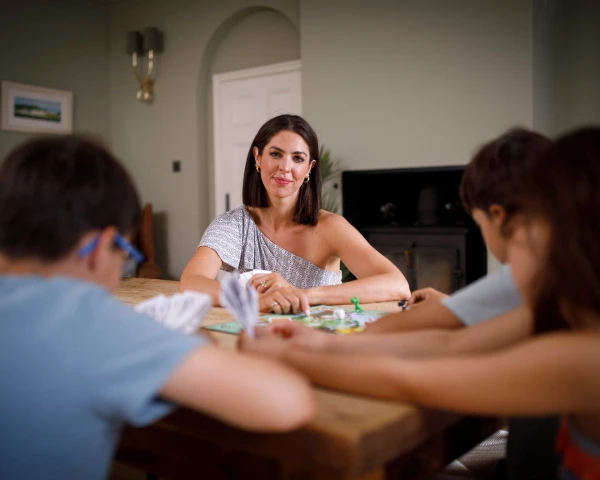
‘My kids see me relaxed and resting’ … Anna Mathur. Photograph: Alicia Canter/The Guardian
‘My kids see me relaxed and resting’ … Anna Mathur. Photograph: Alicia Canter/The Guardian
The one change that workedLife and style
The one change that worked: I banned myself from social media – and my children have never been happier
I used to think my phone helped me to relax. But setting strict limits on my usage has improved my mood and my relationships
Anna Mathur
Mon 6 Jul 2026 06.00 EDT
Share
I am a psychotherapist who works with frazzled, snappy parents, and spend my days writing about why we struggle to find calm. I also used to pick up my phone hundreds of times a day, failing to realise that it was making me a snappier, more irritable, less present mother.
My phone was my office, my income, my means of communication. Every time I checked it, there was something to action, a notification of something new, something that told me I was useful and productive, giving me dopamine hits that motherhood didn’t offer. It had become my coping mechanism.
The phone was also where I went to decompress, to have five minutes that felt like mine. But while social media appears to be the most stimulating thing in the universe, what felt like rest was actually just a further demand on my already stretched mind.
When I thought about how much time I spent on my phone, I felt ashamed. That number wasn’t just data; it signified the gap between the available mother I wanted to be and the one I was in those moments.
It was only when I started paying attention to what happened in my body when one of my children (aged seven, nine and 11) interrupted me mid-scroll that something shifted. I felt the spike of irritation and heard a sharpness in my voice. I had been treating my snapping as a patience problem and a character flaw, but what I realised is that reaching for your phone more than you want to is not weakness – it’s biology.
‘Now I’m fully present’ … Mathur with her children. Photograph: Alicia Canter/The Guardian
Research shows that for those of us with ADHD, or tired from chronic stress and poor sleep, the pull of the phone is really strong. Impulse control is a frontal lobe function, and that part of our brain weakens when we are tired or overwhelmed. I was going through perimenopause, which makes it harder still as oestrogen declines and the brain becomes more reward-seeking.
I promised to limit my use, but I’d break my own rules every time. So I stopped relying on willpower and downloaded an app called App Block. I cannot access social media or my email during the hours my children are home, and I have 15 minutes to check in once they’re in bed. If I need to do something for work, I go to my laptop, which feels far more intentional.
What I didn’t expect was how much calmer I would feel. The low hum of overstimulation I had normalised turned out to be costing me more than I knew. My nervous system finally had room to breathe. I was less irritable, more present, in a way that didn’t require effort.
One habit that helped was narrating my phone use out loud. When I pick it up in front of the kids, I say: “I’m just adding bananas to the shopping.” It keeps me accountable, because once I’ve said it, I do that one thing and put it down. And it tells my children that I’m not disappearing, as I used to.
The one change that worked: I swapped doomscrolling for reading comic books Read more
Now, when the kids settle in front of the television in the evening, I laze with them and read a book. Being spoken to mid-chapter doesn’t spike stress in the same way. There’s no algorithm or notification vying for my attention. I’d forgotten what it felt like to be bored, where rest lives and ideas surface.
And this change has improved my relationship with my husband. Much of our evenings together had been sitting side by side on our phones, each somewhere else entirely. Without the phone as my default, I’m more available. It’s improved our relationship in ways I didn’t anticipate. We talk more, debriefing over our days. We give each other more undivided attention, which is the most valuable thing you can give anyone.
Reducing the time I spent on my phone has deepened my most important relationships, and that is no small thing. My kids see me relaxed and resting. They tell me about the small details and worries of their days, they snuggle up to me. These moments are so special and now I’m fully present for them.
Anna Mathur is a psychotherapist and author. Her new book, How to Stop Snapping at the People You Love, is published by Penguin Life.
Do you have an opinion on the issues raised in this article? If you would like to submit a response of up to 300 words by email to be considered for publication in our letters section, please click here
Every recipe, ready for your kitchen
The Feast app has thousands of recipes from US and world-class cooks and exclusive features that make everyday cooking easier:
•Browse through recipes with enhanced search and filters
•Curate your own recipe collections in My Feast
•Metric or cups? Your choice
•Create your own shopping list
•Use cook mode for step-by-step instructions
•Print your favourite recipes
Start your 14-day free trial today
Explore more on these topics
- Life and style
- The one change that worked
- Parents and parenting
- Family
- Mobile phones
- Social media
- features
Share
Most viewed
- #### China tests long-range missile in South Pacific in move Australia condemns as ‘destabilising to region’
- #### Australian Space Agency reveals likely origin of mysterious ‘space balls’ found on Queensland beaches
- #### Buckingham Palace says Harry can no longer stay at royal residence on UK visit
- #### Archaeologists uncover ancient Byzantine city in Egypt’s western desert
- #### Turkey blocks cruise ship carrying 2,000 LGBTQ+ passengers and a ‘furious’ Patti LuPone, citing ‘moral values’
The one change that worked
The one change that worked
- ### The one change that worked: I saw a woman lift 100kg and decided: ‘I want to do that!’ 22 Jun 2026
- ### The one change that worked: my husband and I created a simple and life-changing parenting rota 8 Jun 2026
- ### The one change that worked: I struggled to get any work done – until I bought a kitchen timer 25 May 2026216 216 comments
- ### The one change that worked: I felt like an outsider in my village – until I found a simple way to connect 11 May 202680 80 comments
- ### The one change that worked: I swapped doomscrolling for reading comic books 27 Apr 2026220 220 comments
- ### The one change that worked: in a hectic world, taking up jigsaw puzzles calmed my mind 13 Apr 202697 97 comments
- ### I took off my headphones – and noticed a stranger in peril 30 Mar 202689 89 comments
- ### I couldn’t stop worrying – until I learned about the 6.30pm rule 16 Mar 2026241 241 comments
More from Lifestyle
More from Lifestyle
-
### The Guest review – Trine Dyrholm pulls out all the stops as a bipolar mother in dysfunctional family drama
2h ago
-
### The pet I’ll never forget: Popcorn, the hamster who calmed me when nothing else could 3h ago
-
### Couples Weekend review – Alexandra Daddario annd Josh Gad lead spicy comedy of marital melee
3h ago
-
### Big brewers ‘misleading drinkers’ over craft beer credentials, says Camra 6h ago
-
### Is it true that … we should eat every two to three hours to boost our metabolism? 6h ago
-
### ‘It was pretty depressing when Stranger Things ended’: Finn Wolfhard on growing up on TV – and his new life in music 9h ago
Most viewed
Most viewed
Most viewed Across the Guardian
-
China tests long-range missile in South Pacific in move Australia condemns as ‘destabilising to region’
-
Australian Space Agency reveals likely origin of mysterious ‘space balls’ found on Queensland beaches
-
Buckingham Palace says Harry can no longer stay at royal residence on UK visit
-
Archaeologists uncover ancient Byzantine city in Egypt’s western desert
-
Turkey blocks cruise ship carrying 2,000 LGBTQ+ passengers and a ‘furious’ Patti LuPone, citing ‘moral values’
-
Live World Cup 2026: England set up Norway quarter-final after Mexico thriller; Uefa says Fifa ‘crossed line’ over Balogun – live
-
Trump is a danger to US democracy. But the resistance is working
-
The Atlantic republishes JD Vance’s anti-Trump essay from 10 years ago
-
Melbourne teacher dies after head clash during suburban football game
-
Unwelcome and undue: Trump’s red-card intervention hurts the US’s World Cup more than it helps
Most viewed in Life and style
-
Shot by a robber, I was bleeding out on the way to hospital – and terrified the doctors would leave me to die
-
The kindness of strangers: My son was unconscious and I frantically called out for help – then five teenagers came running
-
Why put solar panels on green space when we could put them over car parks?
-
The one change that worked: I banned myself from social media – and my children have never been happier
-
‘It was pretty depressing when Stranger Things ended’: Finn Wolfhard on growing up on TV – and his new life in music
-
The pet I’ll never forget: Popcorn, the hamster who calmed me when nothing else could
-
Readers reply: Are there places on Earth where humans haven’t been?
-
How do I cope with my grief and guilt after losing my husband?
-
‘Smaller doses of exercise are a miracle cure’: 14 expert tips to protect your joints
-
The moment I knew: I woke up and couldn’t see out of my right eye. Hours later, she helped me record an album
Original reporting and incisive analysis, direct from the Guardian every morning
-
California resident – Do Not Sell or Share
Support the Guardian
Available for everyone, funded by readers
© 2026 Guardian News & Media Limited or its affiliated companies. All rights reserved.(dcr)