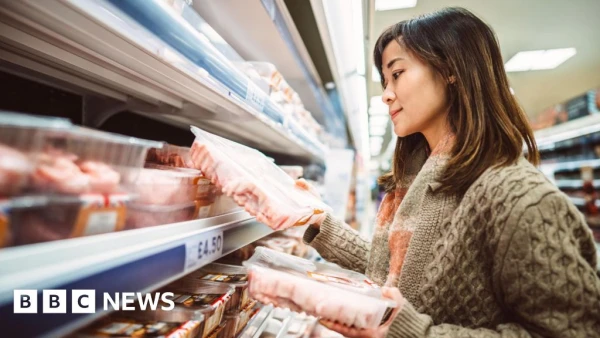
The UK government is preparing contingency plans for potential food shortages this summer, including chicken and pork, as the conflict in Iran continues to disrupt global supply chains. Officials have outlined a worst-case scenario involving the prolonged closure of the Strait of Hormuz and potential breakdowns in carbon dioxide (CO2) supplies, which are critical for animal slaughter and food preservation.
A government source revealed that these plans are precautionary, with a Department for Environment, Food & Rural Affairs spokesperson stating: "Reasonable worst case scenarios are a planning tool used by experts and are not a prediction of future events." The department emphasized ongoing collaboration with businesses to mitigate the war's impact.
Industry leaders express greater concern about price inflation than immediate shortages. Richard Griffiths, chief executive of the British Poultry Council, noted: "Our members are not reporting any difficulties so far, but we are monitoring the situation closely." The British Retail Consortium acknowledged retailers' experience in managing supply chain disruptions but warned that the Middle East conflict "continues to add inflationary pressures at a time when retailers already face significant new costs from domestic policies."
Business Secretary Peter Kyle reassured the public, telling Sky News that CO2 availability is not currently a concern for the British economy. "Right now, people should go on as they are," he said. Tesco CEO Ken Murphy echoed this sentiment, stating: "We are not flagging any issues in our supply chain at this point... we're not seeing any availability issues. We are in very good shape."
The conflict's economic ripple effects are already evident. Since the US and Israel launched strikes on Iran in late February, and Iran subsequently closed the Strait of Hormuz, petrol and diesel prices have surged globally. This closure has increased costs for fuel and fertilizer, both essential for food production.
In response to potential CO2 shortages, the government recently temporarily restarted the Ensus bioethanol plant, which produces CO2 as a byproduct. A spokesperson for Ensus expressed confidence in meeting the country's CO2 needs "for the foreseeable future."
Kevin White, international trade editor at The Grocer magazine, highlighted the critical yet overlooked role of CO2 in the food supply chain, calling it "the input that nobody knows about, or cares about, until something goes wrong." He predicted that supply chain disruptions would likely drive food inflation, noting that thin margins across the supply chain leave little room to absorb price shocks.
The International Monetary Fund has warned that the war could trigger a global recession, with the UK potentially facing the hardest impact among advanced economies. The Food and Drink Federation forecasts food inflation could reach at least 9% by December.
Agricultural experts warn of broader implications. The National Farmers' Union anticipates price increases for cucumbers and tomatoes in the coming weeks, with other crops and milk likely to follow in the next three to six months. Jo Gilbertson of the Agricultural Industries Confederation cautioned that rising fertilizer prices could affect autumn planting decisions, potentially leading to a more severe food crisis if costs become prohibitive for farmers.
Diplomatic efforts to resolve the conflict remain uncertain. US President Donald Trump has suggested talks could resume this week after negotiations recently collapsed, while UK Chancellor Rachel Reeves criticized the US decision to end diplomatic negotiations with Iran, calling it a "mistake."