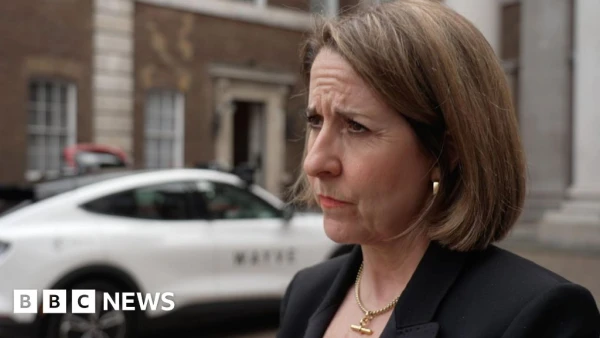
Liz Kendall, the UK's Secretary of State for Science, Innovation and Technology, has made a surprising admission: she doesn't use artificial intelligence in her ministerial work, despite overseeing a major £500 million government investment in the sector.
Speaking during a demonstration of an AI-powered driverless car by British firm Wayve, Kendall told BBC Radio 5 Live and Newsnight that while she champions AI for national security and economic prosperity, her personal use of the technology is limited to private matters.
"Well, I use AI personally rather than at work, I've got to be honest," Kendall said. "I'm much more likely to use it in my personal life."
This contrasts with her predecessor, Peter Kyle, who last year introduced "Humphrey"—a set of government AI tools named after the scheming official from the classic BBC sitcom Yes, Minister. At the time, Kyle declared that "no one should be wasting time on something AI can do quicker and better."
Kendall revealed a particularly personal application of AI: when she developed an allergic reaction to a face cream, she used AI to analyze ingredient lists across multiple products, identify common allergens, and suggest remedies.
"I checked the sources, it came from the National Eczema Society, I went to the pharmacist, I asked her for her best cream, she named the same one, I bought it, it worked," she explained.
Despite her personal approach, Kendall acknowledged that government officials are expected to utilize AI tools. She noted that staff at the Department for Work and Pensions already use AI to rewrite CVs for jobseekers, and the technology could help summarize responses to government consultations.
The minister also addressed concerns about AI's impact on employment, particularly regarding driverless vehicles that could potentially displace hundreds of thousands of licensed taxi and private hire drivers across England.
"I think we've got to level with people that, you know, jobs will be created, jobs will change, some jobs will go, but new ones will take their place," Kendall said.
She emphasized the government's commitment to providing free AI skills training for up to 10 million workers, calling this initiative "really important for the future."
When questioned about broader public concerns—a recent YouGov poll found 75% of Britons worry AI could threaten humanity—Kendall expressed confidence in the technology's safety while acknowledging the need to carefully consider its implications for employment.
"No, I think that how it is developing is safe. We obviously have to think through the implications for jobs," she stated, adding that her historical perspective informs her view that technological revolutions inevitably transform employment landscapes.
The government's £500 million Sovereign AI unit, announced this week, represents a significant bet on British AI companies. Kendall described the investment as "crucial to our national security and economic prosperity," even as her personal approach to the technology remains decidedly hands-off in her professional capacity.