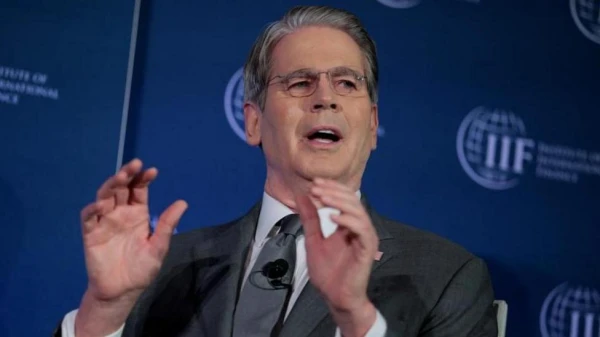
US Treasury Secretary Scott Bessent has argued that temporary economic strain is a necessary price for ensuring long-term global security, as tensions with Iran continue to escalate. In an interview with the BBC, Bessent emphasized that the potential threat of nuclear aggression outweighs short-term financial forecasts.
"I wonder what the hit to global GDP would be if a nuclear weapon hit London... I am saying that I am less concerned about short-term forecasts, for long-term security," Bessent stated.
He pointed to Iran's missile capabilities and nuclear ambitions as justification for ongoing military actions, claiming that recent strikes have reduced the risk of attacks on Western nations. However, the UK government has countered this assessment, maintaining there is no evidence Iran intends to target Europe with missiles.
The International Monetary Fund has issued stark warnings about the economic fallout from the conflict. In its latest World Economic Outlook report, the IMF projected that prolonged hostilities could push global growth below 2% by 2026, potentially triggering a worldwide recession.
"Once again, the global economy is threatened with being thrown off course - this time by the outbreak of war in the Middle East," the IMF report stated.
Energy markets have been particularly volatile since the Strait of Hormuz effectively closed six weeks ago. Oil prices briefly surged to nearly $120 per barrel before settling around $95. The IMF cautioned that if prices remain elevated at $110 this year and climb to $125 by 2027, inflation could reach 6%, forcing central banks to implement aggressive interest rate hikes.
IMF Chief Economist Pierre-Olivier Gourinchas warned that even an immediate resolution would create supply disruptions comparable to the 1970s oil crisis, though modern economies' reduced dependence on fossil fuels might cushion the impact.
Economic forecasts vary significantly by region. The UK is projected to be the hardest-hit advanced economy, with growth estimates slashed to 0.8% this year. Gulf nations face even steeper challenges: Iran's economy is expected to contract by 6.1%, Qatar's by 8.6%, and Iraq's growth will slow by 6.8%. Saudi Arabia appears more resilient, with 3.1% growth projected for 2026 thanks to alternative export routes like its East-West pipeline.
The IMF's projections assume normalization of energy production within months, but officials acknowledge these estimates may need revision if the conflict persists or infrastructure damage proves more severe than anticipated.