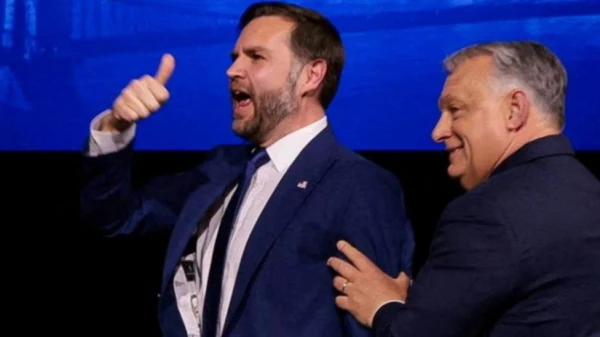
US Vice-President JD Vance has defended his decision to campaign alongside Hungarian Prime Minister Viktor Orbán just days before Orbán's party suffered a decisive electoral defeat. Speaking to Fox News, Vance described Orbán as a "great guy" who performed a "very good job," praising him as one of the few European leaders willing to challenge Brussels' bureaucracy.
Despite expressing disappointment over the loss, Vance emphasized that the United States is prepared to "work very well" with Hungary's incoming government. The election saw opposition leader Péter Magyar's Tisza party secure a landslide victory, capturing a super-majority that enables constitutional changes.
Magyar, who had previously criticized Vance's campaign intervention as foreign interference, struck a more conciliatory tone after his victory. He acknowledged the US as a "strong and important" NATO partner, indicating willingness to engage with the Trump administration.
"No foreign country may interfere in Hungarian elections," Magyar had warned during the campaign, but he later clarified that "if President Donald Trump or anyone else called him he would talk to them."
The political transition now centers on procedural steps, with President Tamás Sulyok expected to convene Hungary's new parliament and recommend a prime minister by May 12. Magyar has pushed for swifter action, suggesting he could assume office by May 5 and labeling Sulyok a "puppet" of the outgoing government.
In a significant media development, Magyar announced plans to appear on public broadcasting—a platform he claims was denied to him during Orbán's tenure. He has pledged to suspend news coverage on state media until it can guarantee unbiased reporting, proposing a BBC-style independent board to oversee public broadcasting.
Magyar's policy agenda includes establishing anti-corruption institutions, pursuing membership in the EU's European Public Prosecutor's Office, and unlocking approximately €33 billion in frozen EU funds. He described Hungary under Orbán as "the poorest and most corrupt member of the European Union," alleging "billions going missing in state contracts."
European Commission President Ursula von der Leyen has already engaged with Magyar, emphasizing the need for "swift work to restore the rule of law and realign with our shared European values." EU leaders are particularly focused on Hungary reversing Orbán's veto of €90 billion in Ukraine aid, though Magyar has indicated the veto may be irrelevant since Hungary previously opted out of the funding mechanism.
German Chancellor Friedrich Merz has urged rapid release of Ukraine assistance following Hungary's government change, with Berlin expected to be among Magyar's first international destinations. The election outcome marks a dramatic shift in Hungarian politics after years of Orbán's rule, with implications for EU unity and transatlantic relations.