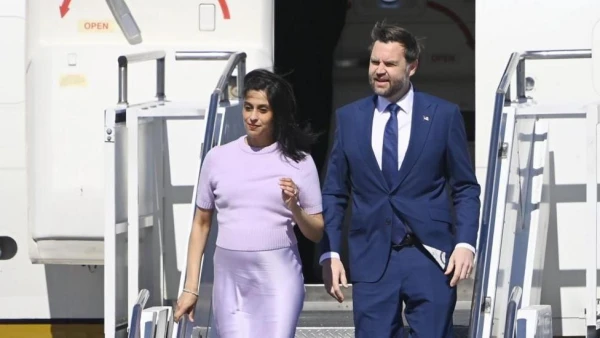
US Vice-President JD Vance has arrived in Budapest to support Hungarian Prime Minister Viktor Orbán ahead of critical parliamentary elections this Sunday, marking a significant show of solidarity from the Trump administration to one of its closest European allies.
Vance is scheduled to participate in a joint press conference and address a campaign rally alongside Orbán at a football stadium on Tuesday. This election represents Orbán's most formidable challenge in his nearly four-decade political career, having secured consecutive victories since 2010.
Hungarian Foreign Minister Péter Szijjártó welcomed Vance and his wife, Usha, telling local media that Orbán's relationship with President Donald Trump has ushered in a "new golden age" for bilateral ties. Last month, Trump publicly declared his "complete and total support" for Orbán in a video message to a conservative conference in Budapest.
Orbán faces opposition from Péter Magyar, a former Fidesz party insider who broke away two years ago to establish the centre-right Tisza party. Most polls show Tisza leading Fidesz by 10% to 20%, with only the pro-government Nézőpont agency placing Fidesz slightly ahead.
The prime minister hopes Vance's presence will sway undecided voters by reinforcing his image as a strong, internationally recognized leader during turbulent times. "I'm looking forward to seeing my good friend Viktor, and we'll talk about any number of things related to the US-Hungary relationship," Vance told reporters before departing Washington. Officials describe this two-day visit as the highest-level US trip since former President George Bush's 2006 visit, though Secretary of State Marco Rubio met with Orbán in Budapest this February.
Orbán's alliance with the US MAGA movement is well-established, with Trump recently stating, "I hope he wins, and I hope he wins big." Their friendship dates to 2016, when Orbán became the sole EU leader to endorse Trump's presidential bid. He strongly supported Trump's 2024 re-election campaign and visited Washington last October to secure a US sanctions exemption for Hungary regarding Russian oil giants Rosneft and Lukoil.
Trump later clarified that this exemption was a personal arrangement between himself and Orbán, implying it might not extend to a successor if Orbán loses the election.
Hungary stands almost alone among EU nations in resisting Brussels' calls to reduce dependence on Russian fossil fuels. During his Washington visit, Orbán also committed to purchasing more US liquefied natural gas, nuclear technology, and fuel. Hungary relies heavily on Russian oil via the Druzhba pipeline from the east and Russian gas through the TurkStream pipeline from the south.
Both supply routes face challenges. The Druzhba pipeline, which crosses Ukraine, has not delivered oil to Hungary since late January. Orbán attributes this to Ukraine's failure to repair the pipeline after a Russian attack on oil infrastructure in western Ukraine on January 27.
Notably, the Trump administration has not offered visible diplomatic support to Hungary on this pipeline issue. To avert shortages, Hungary has released fuel reserves and imported non-Russian oil through an alternative pipeline from Croatia.
A new complication arose on Sunday when Serbian authorities reported discovering and neutralizing explosives near the TurkStream gas pipeline close to the Hungarian border. Orbán and pro-government media labeled it a terror attack on Hungary's energy supply. However, former Hungarian intelligence sources and opposition leader Péter Magyar accused Orbán of orchestrating the incident with Serbian President Alexander Vučić's help to boost his re-election prospects.
Orbán has made opposition to Ukraine and its president, Volodymyr Zelensky, a central theme of his campaign. Recent scandals may have further impacted his popularity, including leaked private telephone conversations between Foreign Minister Szijjártó and senior Russian officials over several years.
Transcripts indicate Szijjártó regularly updated the Russian government on confidential EU summit discussions and advocated for removing Russian officials from sanctions lists at Moscow's request. Szijjártó has defended these calls as "normal diplomacy."