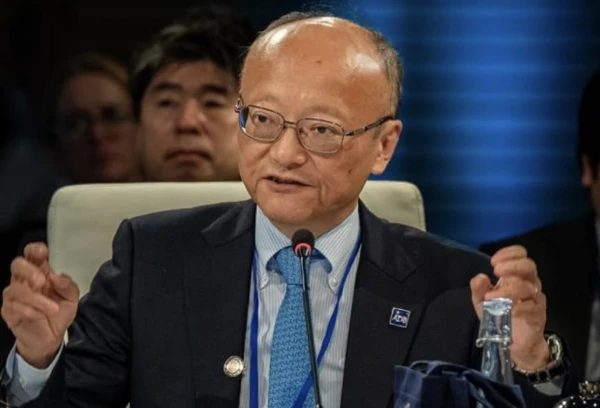
MANILA — Masato Kanda, President of the Asian Development Bank (ADB), has formally declared his candidacy for reelection to a second five-year term, aiming to continue leading the institution through a period of significant global upheaval.
Kanda’s current term concludes on November 23 of this year. In a statement released Wednesday, he emphasized the bank's critical role as a stabilizing force.
“In this era of radical transformation, where the development landscape faces multiple, compounding shocks, the Asian Development Bank serves as an anchor of stability for our developing member countries across Asia and the Pacific,” Kanda stated. “With the trust of our partners, it would be my honor to continue leading ADB. If reelected, my foremost priority will be urgent action to protect our region from today's challenges while building a brighter future for the next generation.”
ADB presidents are nominated from the bank's regional members and elected by its Board of Governors for five-year terms. Kanda was initially elected by the board on November 28, 2024, and assumed office on February 24, 2025, completing the term of his predecessor, Masatsugu Asakawa.
During his tenure, ADB has significantly scaled up its financial commitments. In 2025, the bank committed $29.3 billion from its own resources—a 20 percent increase from the previous year. Combined with $14.7 billion in co-financing from partners, this brought total development finance to $44 billion.
Key regional initiatives advanced under Kanda's leadership include a $10-billion package for the Association of Southeast Asian Nations (ASEAN) Power Grid, over $10 billion for the Central Asia Regional Economic Cooperation (CAREC) Program, and the establishment of a new Regional Connectivity Fund.
The bank also directed $14 billion toward its ambitious $40-billion commitment to transform food systems and is providing support for the Philippines' upcoming ASEAN chairship in 2026.
In response to global crises, ADB became the first multilateral development bank to announce a support package addressing the economic fallout from the Middle East conflict. It has also delivered rapid disaster and emergency response assistance to several countries, including Afghanistan, Myanmar, Pakistan, the Philippines, Sri Lanka, Thailand, and Vietnam.
To meet evolving regional demands, ADB has implemented several strategic reforms under Kanda. These include updating its energy policy to support nuclear power for the first time, launching a new Environmental and Social Framework, and entering a landmark agreement with the World Bank Group to streamline co-financed sovereign projects.
Other significant reforms include the first amendment to the ADB Charter in the institution's 60-year history, which unlocked a 50 percent expansion in operational capacity, and a new Strategic Human Resource Framework designed to keep the bank "agile, capable, and fit for purpose."
Founded in 1966, the Asian Development Bank is owned by 69 member countries, 50 of which are from the Asia-Pacific region.