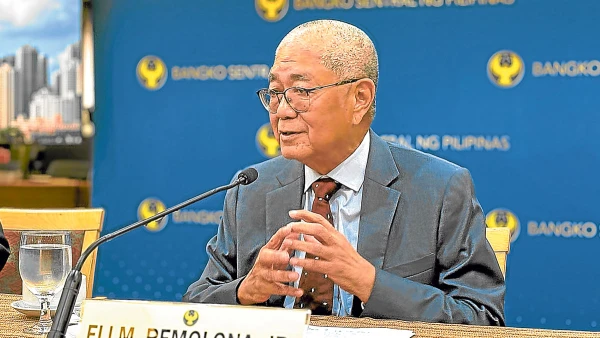
The Bangko Sentral ng Pilipinas (BSP) will tighten monetary policy as needed to control inflation, Governor Eli Remolona Jr. said, indicating that the market can expect a series of "modest" rate increases.
In an interview with Bloomberg, Remolona explained that the central bank aims to stay ahead of inflation, which is broadening as higher oil prices spill over to other consumer goods. "The market needs to understand that we will do what’s necessary to contain inflation, and at the moment, that seems like a succession of modest rate hikes," he said.
Last Thursday, the Monetary Board raised the benchmark rate by a quarter point to 4.5 percent, the first hike in over two years, effectively ending the easing cycle. Higher borrowing costs are intended to temper household spending and ease demand-driven price pressures, even though they risk slowing economic growth.
Remolona acknowledged that interest rate increases are a blunt tool for supply-driven price shocks but said they help anchor expectations and discourage behavior that could fuel inflation. Policymakers project inflation averaging 6.3 percent this year and 4.3 percent in 2027, both above the BSP's 2–4 percent target.
The board also considered a larger half-point increase but decided a smaller move was "the most reasonable scenario," Remolona noted.
Analysts at BMI, a Fitch Group unit, expect another quarter-point hike this year, bringing the key rate to 4.75 percent. "Further inflationary pressures lie ahead," they said, noting that unlike regional peers, the Philippines lacks broad-based price caps, so global energy price increases pass through quickly.
Deutsche Bank Research economist Junjie Huang forecasts two additional quarter-point hikes in June and August, saying, "We think BSP is likely to continue tightening and would choose to act sooner rather than later, especially as it already forecast above-target inflation."