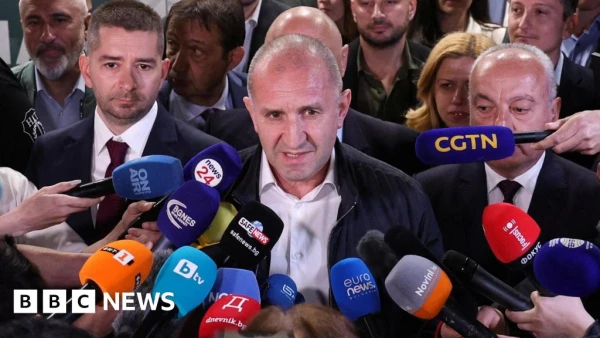
Rumen Radev's Progressive Bulgaria party has emerged victorious in Bulgaria's parliamentary election, marking the country's eighth general election in five years. Exit polls indicate the party secured 37% of the vote, more than double the support for former Prime Minister Boiko Borisov's GERB party, which trailed at 16%. Three to four other parties are projected to surpass the 4% threshold required to enter Parliament.
The election was triggered after the previous government attempted to push through a contentious budget in December, sparking widespread protests that Radev, then serving as president, publicly endorsed. In his victory speech, Radev stated, "People rejected the self-satisfaction and arrogance of old parties and did not fall prey to lies and manipulation. I thank them for their trust." He committed to building "a strong Bulgaria in a strong Europe," emphasizing the need for critical thinking and pragmatic actions within the European Union.
Radev, a 62-year-old former Mig-29 fighter pilot and commander-in-chief of the Bulgarian Air Force, stepped down from the presidency in January to form his new political movement. While his victory is notable by Bulgarian standards, it does not provide Progressive Bulgaria with a strong enough mandate to govern independently. Radev has already indicated he will seek coalition partners, aiming to restore stable governance after years of fragile and easily-toppled coalitions.
Known for his pragmatic and somewhat pro-Russian stance, Radev has criticized EU sanctions and advocated for constructive dialogue with the Kremlin. He opposes direct Bulgarian military support for Ukraine, arguing that such actions prolong a conflict Ukraine cannot win—a position echoed by outgoing Hungarian Prime Minister Viktor Orbán. However, Radev's approach appears nuanced; while critical of EU support for Ukraine, he is not expected to veto arms manufacturing by private companies for the country.
Bulgaria plays a significant role as a supplier of ammunition and explosives to Ukraine through third countries, particularly neighboring Romania. The war has revitalized Bulgaria's arms industry, which had struggled since the Soviet era. In a notable development, German arms company Rheinmetall announced a €1 billion joint venture with Bulgaria's VMZ factory in Sopot in October 2025, aiming to produce up to 100,000 NATO-grade 155mm artillery shells annually. Radev took credit for inviting Rheinmetall's CEO to Bulgaria in March 2025, stating, "Bulgaria is becoming part of the European defence ecosystem."
Analysts suggest Radev's position as head of government may mirror that of Slovak Prime Minister Robert Fico—critical of EU policies but not obstructing private arms production for Ukraine. As coalition talks begin, Radev's leadership will be closely watched for its impact on Bulgaria's domestic stability and its role within European security frameworks.