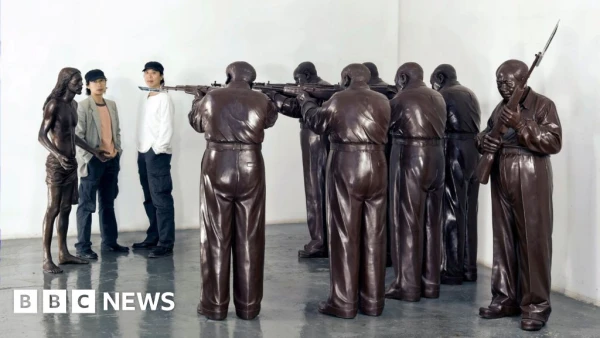
In a case that has sent shockwaves through China's art world, renowned sculptor Gao Zhen faces up to three years in prison for works created over a decade ago, highlighting what observers describe as an alarming escalation in state censorship.
Gao, 69, was arrested at his Beijing studio in mid-2024 while visiting family from his home in the United States. Authorities confiscated his artworks and prevented his wife and seven-year-old son from leaving the country. Last month, he underwent a closed-door trial on charges of "insulting revolutionary heroes and martyrs"—a reference to his provocative sculptures depicting former Chinese leader Mao Zedong.
"Even if a work was made 15 years ago, it can still be turned into a crime if today's political climate changes," said Gao Qiang, the sculptor's brother and artistic collaborator.
The Gao brothers gained international recognition in the 1990s and 2000s for works that critically engaged with China's political history. Among their most famous pieces is "Execution of Christ," featuring Mao Zedong and other historical figures aiming rifles at Jesus Christ, and "Mao's Guilt," depicting the former leader in a kneeling position of contrition.
Experts say the case represents a significant shift in China's approach to artistic expression under President Xi Jinping's leadership.
"We are witnessing probably the darkest period of time in decades for freedom of expression under the CCP," said Ian Johnson, a Pulitzer Prize-winning journalist specializing in China. "The Party is now less willing than ever to countenance criticism of its leaders."
The United Nations human rights office recently called for Gao's immediate release, expressing concern about "retroactive application of criminal law and use of criminal sanctions to punish artistic expression."
Gao's health has deteriorated significantly during his detention. He suffers from chronic lumbar spine disease, arthritis, eye problems, and a severe skin condition, and has appeared in court in a wheelchair on multiple occasions. His brother reports signs of malnutrition, and repeated applications for medical bail have been denied.
The case has drawn parallels to other prominent Chinese artists and activists who have faced persecution, including Ai Weiwei, who was detained in 2011, and Liu Xiaobo, who died in prison in 2017 after receiving the Nobel Peace Prize.
For the Gao brothers, their artistic engagement with Mao's legacy is deeply personal. Their father was persecuted during Mao's Cultural Revolution, a violent campaign that targeted intellectuals, artists, and perceived political enemies.
As China continues to tighten controls across all forms of expression—from visual arts to literature and online writing—Gao Zhen's secret trial serves as a stark reminder of the shrinking space for creative dissent in the world's most populous nation.