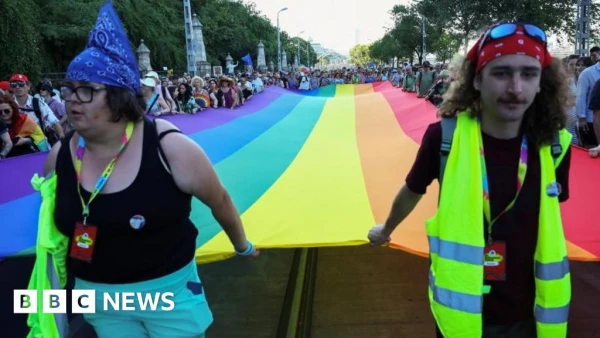
In a landmark decision, the European Court of Justice has declared Hungary's controversial anti-LGBTQ laws incompatible with fundamental European Union values. The ruling marks an unprecedented legal rebuke of legislation championed by former Prime Minister Viktor Orbán's government.
"The Hungarian law was contrary to the very identity of the Union as a common legal order in a society in which pluralism prevails," the court stated in its judgment.
The contested legislation, enacted in 2021, prohibited the so-called promotion of homosexuality or gender transition to individuals under 18 years old. Hungarian authorities justified the measures as necessary for child protection, but the European court found they violated multiple EU principles.
According to the ruling, the laws infringed upon rights including freedom from discrimination based on sexual orientation, respect for private and family life, and freedom of expression. The court further determined that the legislation unjustly stigmatized transgender and non-heterosexual individuals by associating them with criminal behavior.
Legal experts hailed the decision as historic. John Morijn, professor of law and politics at the University of Groningen, told media outlets that the ruling established that minority rights cannot be negotiated away through political processes.
"You cannot equate what is totally natural—that 10% of the population loves the same sex—with egregious crime," Morijn emphasized.
The timing of the judgment carries significant political weight, arriving just nine days after Hungarian voters ended Orbán's 16-year tenure. His successor, Péter Magyar, whose Tisza party secured a parliamentary supermajority, has signaled a more cooperative approach with European institutions.
In his victory address, Magyar outlined his vision for a Hungary "where no-one is stigmatized for thinking differently than the majority, or loving differently than the majority." He has pledged to unlock billions in frozen EU funds previously withheld over rule-of-law concerns.
European Commission spokesperson Paula Pinho indicated that compliance with the court's decision would be a priority in discussions with Hungary's new government. LGBTQ advocacy groups have urged swift action.
"If Péter Magyar truly aims to be pro-EU, he must place this at the top of his agenda for his first 100 days in office," said Katja Štefanec Gärtner of Ilga-Europe.
The ruling establishes a significant legal precedent that could influence future EU actions regarding member states' compliance with fundamental values. Professor Morijn noted that the decision empowers the European Commission to challenge not just technical violations of EU law, but fundamental breaches of the Union's core principles as outlined in Article 2 of the EU Treaty.
Hungary's legislation had already faced practical challenges, with Budapest's 2025 Pride march proceeding despite legal prohibitions, resulting in charges against city officials. The court's decision now creates a clear legal mandate for the legislation's repeal as Hungary transitions to new leadership.