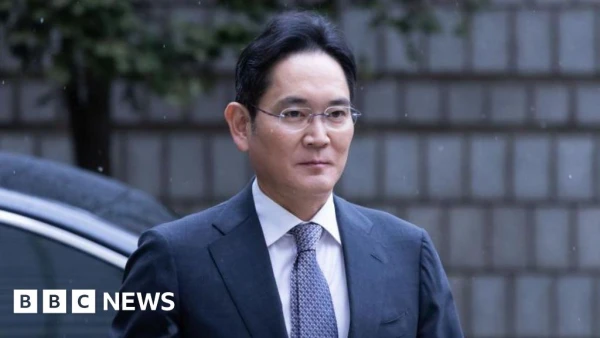
When leadership changes at the world's largest corporations, it usually goes unnoticed. But for Samsung, the family dynasty behind the tech giant is so intertwined with South Korea's economy that any shift in power makes headlines.
In 2017, Lee Jae-yong, the grandson of Samsung's founder and heir apparent, was jailed for his role in a corruption scandal that also brought down the country's president. The 57-year-old, known as JY Lee, was convicted of bribery for funneling money to foundations controlled by Choi Soon-sil, a confidante of former President Park Geun-hye. In return, prosecutors said, he sought political support for a controversial merger that would solidify his control over the conglomerate.
Lee has always denied the fraud charges, but the scandal sparked massive protests in Seoul and led to President Park's impeachment.
Why the merger mattered
Samsung began as a grocery store in the 1930s and has remained in the Lee family ever since. According to Geoffrey Cain, author of Samsung Rising, the family is considered "the equivalent of royalty" in South Korea. Over the decades, they expanded into insurance, memory chips, construction, and consumer electronics, turning Samsung into a global powerhouse.
But maintaining family control required complex mergers, acquisitions, and power transfers. This intricate maneuvering ultimately landed Lee Jae-yong in prison.
Lee had been acting as de facto chairman since 2014, when his father, then-chairman Lee Kun-hee, suffered a heart attack. The elder Lee had transformed Samsung from a local business into a global empire. Yet when JY took the reins, the processes ensuring total family control were incomplete. The conglomerate comprised dozens of interlinked companies—from Samsung Electronics to retail—all tied together by cross-shareholdings.
Compounding the issue was an enormous inheritance tax bill exceeding $10 billion. Selling shares to pay it could jeopardize the family's control.
The risk of succession
Despite being groomed for 30 years, Lee Jae-yong was seen by some as an unconvincing choice to lead Samsung, and by extension, South Korea's economy. Jaeyeon Lee, a reporter at the Hankyoreh newspaper, described him as "shy and quiet and cautious"—a stark contrast to his aggressive, goal-oriented father. Some observers believed his sister was more capable, and his earlier venture, e-Samsung, collapsed during the dot-com bust.
This wasn't the first troubled succession. A generation earlier, Lee Jae-yong's father—the youngest son—was chosen to lead over his two older brothers. The eldest, Lee Maeng-hee, claims he ran the company for seven years before being pushed aside. In 1976, the youngest was named heir, a decision that would echo for decades.
The empty chair
After a rocky start, Lee Kun-hee steered Samsung to extraordinary success in the 1980s and 1990s. But in 2008, both he and his son resigned after a former Samsung lawyer blew the whistle on a slush fund used for bribes and political payoffs. The lawyer said he "couldn't stomach the corruption anymore."
This left Samsung leaderless. Lee Kun-hee was later cleared of bribery but convicted of tax evasion, receiving a suspended sentence. The question remained: how would the Lee family regain control?
The 40-year feud
Lee Kun-hee eventually received a presidential pardon and returned as chairman. But in 2012, his elder brother—Lee Jae-yong's uncle—launched a legal bid to reclaim his inheritance, threatening the next generation's succession plan. The founder's eldest son had always believed he would one day lead the business, but was overlooked in favor of his younger brother.