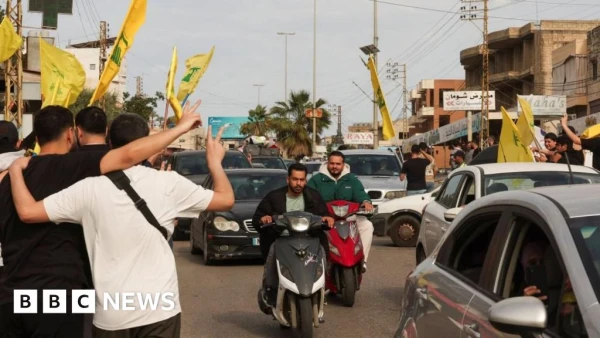
At midnight, the crackle of celebratory gunfire and fireworks pierced the Beirut sky, heralding a tenuous ceasefire between Israel and Hezbollah. This pause, following six weeks of intense conflict, offers a moment of respite for a nation reeling from widespread displacement and destruction.
Throughout the morning, crowds gathered along roads leading south, waving Hezbollah's yellow flags and playing revolutionary anthems as families began returning to areas they had fled. The scene was one of cautious movement—mattresses strapped to car roofs and families on motorbikes—yet for many, the homecoming is temporary. Lebanese health authorities report over 2,100 fatalities and approximately one million people displaced, underscoring a severe humanitarian crisis.
In the heavily damaged southern suburbs of Beirut, known as Dahieh, the streets remained subdued. Many residential buildings lie in ruins after sustained Israeli bombardment. Along the waterfront, where displaced families have sheltered in makeshift tents, fear of returning persists. Some villages near the border remain under Israeli control, and extensive damage has left others with nothing to return to.
The ceasefire, announced by U.S. President Donald Trump, leaves critical questions unanswered. It does not address the withdrawal of Israeli troops from southern Lebanon, raising concerns that a 'security buffer zone' may become a lasting occupation, preventing residents from returning home. Furthermore, the issue of Hezbollah's disarmament—a long-standing point of contention—remains unresolved. The U.S., Israel, and many Lebanese citizens demand the militia lay down its arms, accusing it of prioritizing Iranian interests and dragging Lebanon into conflict.
In a rare interview with the BBC, Wafiq Safa, a senior Hezbollah political council member, stated unequivocally that the group would "never, ever" disarm. He emphasized an inseparable bond with Iran, describing it as "two souls in one body." This stance complicates domestic efforts, as the Lebanese government holds little sway over Hezbollah. President Joseph Aoun has warned that disarmament cannot be achieved by force and requires negotiation, though observers note any decision likely rests with Tehran, not Beirut.
Adding to the fragility, the agreement permits Israel to continue attacks on Lebanon citing security concerns, potentially reverting to the pre-conflict status of near-daily strikes on Hezbollah-linked targets. While President Trump envisions this ceasefire as a step toward normalizing Israel-Lebanon relations—neighbors technically at war since 1948—the path forward appears fraught. With ongoing occupation and Hezbollah's entrenched position, the truce offers a fragile breather, but the obstacles to a durable peace remain deeply entrenched.