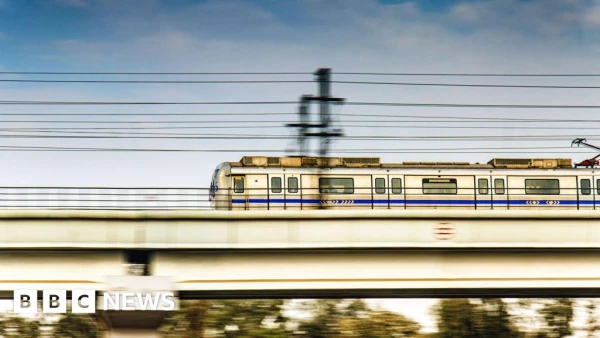
India has invested a staggering $26 billion in developing metro rail networks across nearly two dozen cities over the past decade, yet many of these modern transit systems are running with alarmingly low passenger numbers.
On a recent weekday evening, Mumbai's new Aqua Line metro—a fully underground route connecting historic Cuffe Parade with business hubs and airport terminals—was nearly empty just stops before its final destination. The terminal resembled a deserted structure rather than the bustling transport hub planners envisioned. The 33.5-kilometer corridor, which opened last year with projections of 1.5 million daily riders, is currently carrying only about a tenth of that volume.
"Not a lot of people are using the line. It's too expensive," a ticketing executive at Cuffe Parade station reported.
This pattern of underwhelming ridership extends far beyond Mumbai. Since 2014, India's metro network has expanded fourfold from under 300 kilometers to over 1,000 kilometers, with daily ridership growing from three million to over 11 million passengers. However, these impressive aggregate figures conceal troubling realities.
"Most metro systems in India have failed to achieve even a sliver of the ridership projected during their planning stages," according to transportation experts.
A 2023 Indian Institute of Technology Delhi study revealed that ridership across various corridors reached only 25-35% of projected figures, with little improvement expected in subsequent years. Other research confirms these findings: in tier-3 cities like Kanpur, ridership was as low as 2% of estimates, while Chennai's first phase achieved just 37% of projected numbers. Cities including Pune and Nagpur reported actual ridership between 20-50% of expectations.
Delhi's extensive network stands as a rare exception where usage has slightly exceeded projections, though experts note this may be due to counting interchanges as separate trips.
So why are these modern transit systems struggling in a country where car ownership remains relatively low and traditional public transport is notoriously overcrowded?
Transportation analyst Ashish Verma points to flawed demand forecasting: "It is a complex task, and figures are sometimes exaggerated to show the project is economically viable." He explains that projections often assume optimal conditions—such as specific train frequencies and coach numbers—that are rarely achieved in practice. In Bengaluru, for instance, peak-hour train frequency ranges from five minutes on busy lines to 25 minutes on newer routes, far from the 90-second intervals common in the world's busiest metro systems.
Affordability presents another significant barrier. A single journey on Mumbai's Aqua Line costs 10-70 rupees, while a three-month unlimited pass on the city's suburban railway costs just 590 rupees. For lower-income workers, integrated metro journeys can consume 20% of their income, exceeding the global benchmark of 10-15%.
"Even the London Tube till today is heavily subsidized. Because there is a purpose. You are trying to provide sustainable mobility and decongest the city," Verma notes.
When Bengaluru metro raised fares last year, ridership dropped approximately 13%, prompting citizen protests. Transportation planners emphasize that reducing subsidies in a price-sensitive market like India may undermine the very purpose of public transit systems.
Additional challenges include poor network planning and inadequate last-mile connectivity. Nandan Dawda of the Observer Research Foundation explains: "People will switch to public transport only when waiting times are as low as possible." India's metro systems often lack sufficient feeder buses, creating inconvenient gaps between stations and final destinations.
Institutional fragmentation compounds these problems, with different operators managing various metro lines and bus networks within single cities, often working in isolation rather than coordination. At Delhi's Hauz Khas station, transferring between lines can take 15-20 minutes due to poor integration.
Safety concerns and inadequate pedestrian infrastructure further deter potential riders. "If I am a tourist even in a city like Delhi, I can't drag my bag to the metro easily and walk to my hotel 500 meters away," Verma observes. For residents like Chetna Yadav, a 40-year-old living in north Delhi, safety remains a primary consideration when choosing transportation options.
Despite these challenges, experts anticipate gradual increases in metro usage as urban traffic congestion worsens across India's rapidly growing cities. The question remains whether these expensive transit investments will achieve their promised transformation of urban mobility or continue to operate below their potential.