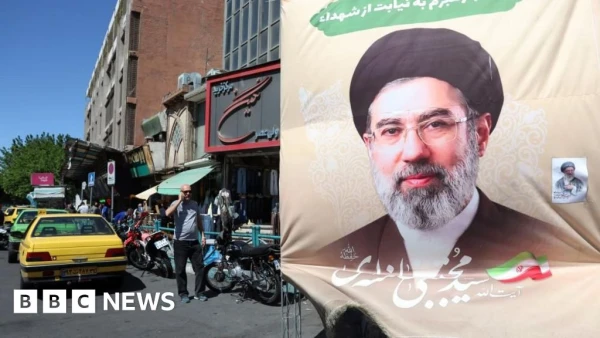
Since the outbreak of war with the US and Israel on February 28, a pressing question has lingered over Tehran: Who is actually in charge?
Formally, Mojtaba Khamenei succeeded his father Ali Khamenei as Supreme Leader, a position that traditionally wields final authority on matters of war, peace, and national strategy. Yet in practice, the leadership appears fractured and opaque.
US President Donald Trump has described Iran's leadership as "fractured," waiting for a unified proposal from Tehran. Iranian officials, in turn, have sought to project unity, distributing a message to citizens stating there is "no such thing as a hardliner or moderate."
The invisible leader
Mojtaba Khamenei has not been seen in public since taking power. Beyond a few written statements—including one insisting the Strait of Hormuz remains closed—there is little evidence of his daily control. Iranian officials acknowledge he was injured in the initial strikes but provide few details. The New York Times reported, citing Iranian sources, that he may have suffered facial injuries making it difficult to speak.
This absence is critical. In Iran's political system, authority is performative: the late Khamenei signaled intent through speeches and public arbitration. That function is now missing, creating a vacuum of interpretation. Some argue his wartime elevation hasn't allowed him to establish authority; others question whether he can actively manage the system at all.
Diplomatic channels open but limited
On paper, diplomacy sits with the government. Foreign Minister Abbas Araghchi represents Tehran in US talks, but neither he nor President Masoud Pezeshkian appears to set strategy. Their authority is further undermined by Parliament Speaker Mohammad-Bagher Ghalibaf heading the delegation.
Araghchi's role seems operational, not directive. His brief reversal on whether the Strait of Hormuz was open or closed—first claiming traffic resumed, then retracting—revealed how little control diplomats have over military decisions. Pezeshkian has aligned with the regime's direction without shaping it, avoiding an independent line.
Stalled second-round talks in Islamabad reinforce the point: even when channels are open, the system seems unable or unwilling to commit.
Military expanding its remit
Control over the Strait of Hormuz is Iran's key leverage, but decisions on closure rest with the Islamic Revolutionary Guard Corps (IRGC), led by Ahmad Vahidi, not the diplomatic team. This places real power behind closed doors. Unlike previous crises, no single figure clearly owns strategy; instead, actions come first, messaging later—and often inconsistently.
The IRGC's actions—enforcing the Hormuz closure, striking targets across the Gulf—appear to set the crisis's pace. Political and diplomatic responses follow rather than lead. This suggests the IRGC's operational autonomy has widened in the absence of clear political arbitration.
Ghalibaf steps forward
Into this ambiguity steps Mohammad-Bagher Ghalibaf. A former Revolutionary Guard commander now Parliament Speaker, he has emerged as a visible figure, inserting himself into negotiations, addressing the public, and framing the war pragmatically. Yet within parliament and conservative networks, resistance to negotiations remains strong. Hardline messaging intensifies, framing talks as weakness.
Ghalibaf's position is precarious—active but not clearly authorized. He claims his actions align with Khamenei's wishes, but visible coordination is lacking. In a system that depends on top-down signals, that ambiguity speaks volumes.
Claimed or exercised coherence?
These dynamics point to a system that functions but lacks coherent direction. The Supreme Leader's authority exists but isn't exercised. The presidency is aligned but not leading. Diplomacy is active but not decisive. The military holds key levers without a clear public architect. Political figures step forward without uncontested legitimacy.
This isn't collapse—the Islamic Republic remains intact. But it reveals a system struggling to convert leverage, like controlling the Strait of Hormuz, into clear strategy under acute pressure. It can act across multiple fronts but struggles to signal clear direction internally. In Iran's political model, signaling is how coherence is maintained.
For now, the system holds the line, avoiding visible breakdown. But increasingly, it raises the question: Is coherence being exercised or merely claimed?