In recent days, the US-Israeli conflict with Iran has escalated, threatening peace efforts. US strikes killed at least 18 Iranians and wounded many more. The fate of the memorandum of understanding (MoU) between the US and Iran, meant to guide peace talks, is now in doubt.
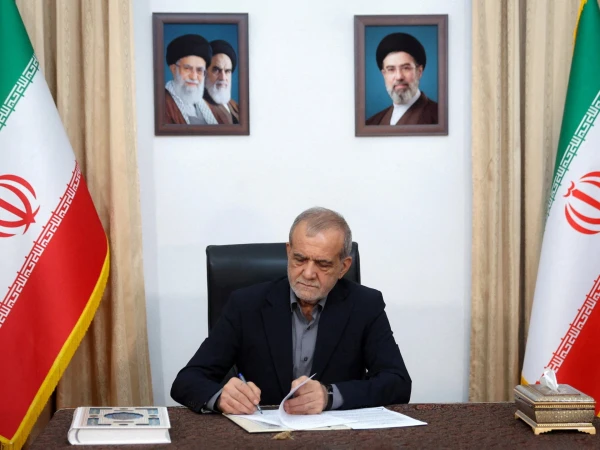
As anger mounts among the regime's supporters, official rhetoric increasingly blames President Masoud Pezeshkian for the perceived failure. This scapegoating aims to distract from internal divisions among the ruling elite.
The Blame Game
Days after the MoU was signed, Supreme Leader Mojtaba Khamenei issued his first public statement on the deal. He claimed he had "a different view" and only permitted it because Pezeshkian, as head of the Supreme National Security Council, had committed to safeguarding Iran's rights and the "Resistance Front" and had "explicitly accepted responsibility."
Notably, the statement omitted the actual negotiator, Parliament Speaker Mohammad Bagher Ghalibaf. Foreign Minister Abbas Araghchi had stated that Ghalibaf was entrusted with the negotiations. By leaving out Ghalibaf, the supreme leader ensured that if the MoU succeeds, Ghalibaf gets credit; if it fails, Pezeshkian takes the blame.
Fractures in Iran's Ruling Bloc
The MoU was engineered by Iran's true ruling bloc: the military-bonyad complex, merging the Islamic Revolutionary Guard Corps (IRGC) and security forces with revolutionary foundations. This complex controls most of Iran's economy beyond civilian oversight. However, it is not monolithic.
The war and MoU have exposed a split between a technocratic-economic wing, personified by Ghalibaf, and an ideological-maximalist wing organized around the Paydari Front, which opposes any engagement with the US. A key dispute centers on a proposed $300 billion Reconstruction and Development Fund. Ghalibaf's camp sees it as necessary for economic recovery; Paydari views it as a threat to sovereignty.
Ghalibaf's wing won the internal debate, but now that the MoU is faltering, he is unlikely to be held accountable due to his close ties to Khamenei and IRGC backing. Pezeshkian, lacking such support, is the perfect scapegoat.
A Presidential Circuit Breaker
Pezeshkian was chosen as president precisely because he lacks the political weight of predecessors like Rafsanjani, Khatami, or Rouhani. He was elevated in 2024 to rebuild public trust without threatening the ruling complex's authority. His weakness is not accidental; it makes him ideal to absorb blame.
The presidency has become a circuit breaker: installed to take the fall if the deal fails, but bypassed if it succeeds. IRGC-linked media have offered limited protection to Pezeshkian against Paydari's attacks, but only as long as the MoU survives.
This strategy echoes the playbook of Ali Khamenei, who approved nuclear diplomacy while publicly distrusting the US. The son, Mojtaba, has refined it by pinning responsibility on a named official. Scapegoating Pezeshkian temporarily spares the ruling complex from open conflict, but the underlying fracture between factions that favor economic integration and those demanding permanent confrontation remains. Eventually, no scapegoat can prevent the coming power struggle within the regime.
The views expressed in this article are the author's own and do not necessarily reflect Al Jazeera's editorial policy.