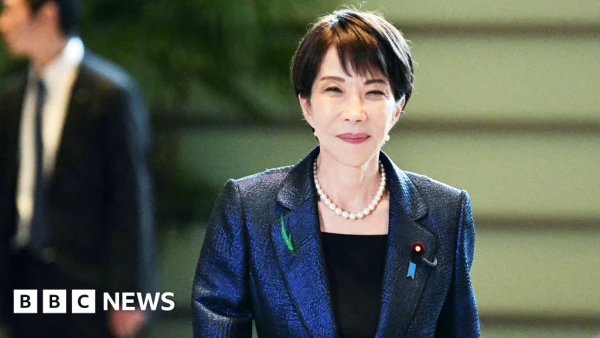
Japan has announced a significant relaxation of its arms export regulations, marking a notable departure from the pacifist principles that have defined its defense policy since World War II. The new rules, unveiled on Tuesday, will allow Tokyo to sell lethal weapons to 17 countries with which it has existing defense agreements, including the United States and the United Kingdom.
"In an increasingly severe security environment, no single country can now protect its own peace and security alone," Japanese Prime Minister Sanae Takaichi stated on social media platform X.
Under the revised framework, Japan will lift restrictions that previously limited arms exports to only five non-lethal categories: rescue, transport, warning, surveillance, and minesweeping. While a ban on sales to nations actively engaged in conflict remains, exceptions may be granted for countries with defense pacts with Japan under "special circumstances."
Chief Cabinet Secretary Minoru Kihara emphasized that the policy shift is "intended to safeguard Japan's security and further contribute to the peace and stability of the region." The announcement coincides with Japan's Self-Defence Forces participating as combat units in annual joint military exercises between the U.S. and the Philippines—a first for Tokyo, which had previously only observed such drills.
China has expressed strong opposition to the move, with its foreign ministry stating it is "seriously concerned" about what it termed Japan's "reckless militarisation." Beijing also criticized the military exercises in the Philippines, which occur near waters and islands it claims, including Taiwan. China views Taiwan as a breakaway province and has not ruled out using force to assert control.
South Korea, which endured Japanese colonization from 1910 to 1945, responded cautiously, urging that Japan's defense policies "should ideally be carried out in a manner that upholds the spirit of the Peace Constitution while contributing to peace and stability in the region."
Japan's pacifist stance was enshrined in its post-war constitution in 1947, which renounced war as a means of settling international disputes. However, recent years have seen gradual changes. In 2014, then-Prime Minister Shinzo Abe eased a blanket ban on military sales, permitting joint arms development with allies. In 2023, his successor Fumio Kishida allowed exports of finished lethal weapons for the first time since World War II.
Prime Minister Takaichi, who took office in October 2025, has advocated for revising the constitution, potentially amending Article 9—the clause that renounces war. Supporters argue that Japan must adapt to a new security reality, given its proximity to China, Russia, and North Korea. Critics, however, fear the country may become increasingly drawn into military conflicts.