Marikina City stands as a beacon of cleanliness in the Philippines, its streets remarkably free of litter thanks to a pioneering waste management system rooted in a policy enacted over two decades ago. The secret lies in a simple yet strictly enforced rule: every household, vendor, and business must segregate their trash at the source.
"We have an ecological solid waste management system. The key in Marikina is that we teach everyone—every resident, every vendor, every establishment—to segregate their trash right where it's generated," explained Oliver Villamena, head of the City Environmental Management Office (Cemo).
This foundational practice is mandated by City Ordinance No. 046, passed in 2002, which carries a significant deterrent: a P2,000 fine for non-compliance. Villamena credits this penalty with ensuring widespread adherence. "That's where they are afraid, the penalty, because it's P2,000. So, they really follow," he noted.
The city's success wasn't instantaneous. It was built on a foundation of extensive public education. Before enforcement began, Cemo officials conducted a massive campaign, visiting neighborhoods to hold seminars and distribute instructional materials, including refrigerator magnets designed like garbage bags to illustrate proper sorting.
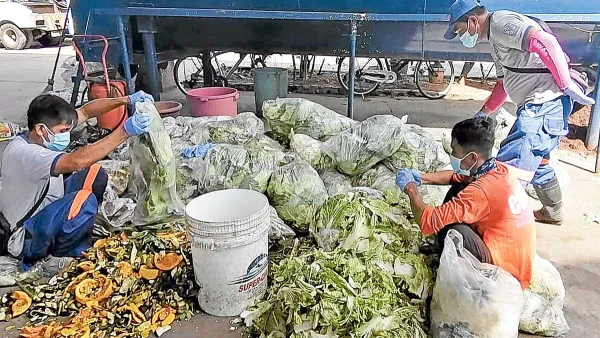
"Once the garbage is segregated at source, this helps prevent contaminating the trash. For example, in restaurants, they really separate the food waste into a separate container. Our specialized food waste truck collects it and transports it directly to our composting facility."
This door-to-door collection is systematic and organized, allowing officials to verify proper segregation. The city collects waste three times weekly—biodegradables twice and recyclables once.
The segregated waste then enters an innovative processing chain. Food scraps from markets and restaurants are fed into one of the city's two bioreactors, transforming them into nutrient-rich compost for use as fertilizer.
For non-biodegradable materials like styrofoam and plastics, Marikina employs a creative solution: a styro-plastic densifier. Combined with used cooking oil, these materials are melted and formed into solid blocks, which are repurposed as paving stones for pathways, pavements, and tiles.
This comprehensive, closed-loop system—from strict source segregation to innovative recycling and composting—demonstrates how consistent policy, public education, and dedicated enforcement can create a sustainable model for urban cleanliness that has endured for generations.