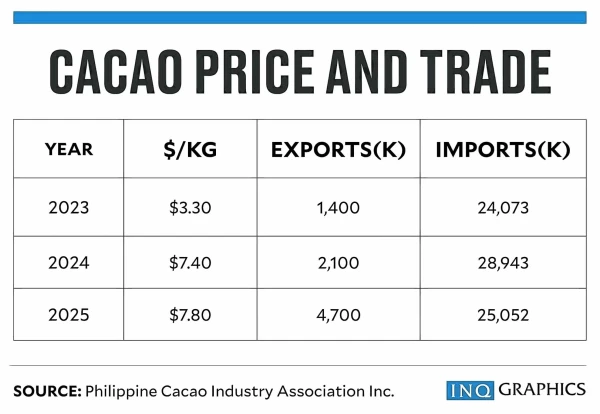
The recently unveiled Cacao Road Map 2026–2030 breaks the mold of previous Philippine agriculture plans. Unlike earlier commodity road maps—often drafted with minimal private-sector input and left to gather dust—this one puts the private sector in the driver's seat.
Led by the Philippine Cacao Industry Association (PCIA) under President Armi Garcia, and backed by the public-private Philippine Cacao Industry Council, the roadmap was shaped with deep involvement from farmers, businesses, and local governments. Key support came from Agriculture Undersecretary Philip Young and Secretary Francisco Tiu Laurel Jr.
"One voice, one cacao family, one Philippine brand"
The plan focuses on three objectives: higher productivity, export competitiveness, and sustainable growth. Two central strategies drive it:
- Clustering to achieve economies of scale, inspired by successful models in Thailand and by top Philippine agri-entrepreneurs.
- Intercropping cacao with coconut trees. A P60,000 per hectare investment is recouped in three years, yielding a 55–100% return on investment and annual net income of P105,000—five times the current P20,000 from coconuts alone.
Current Status & Potential
The Philippines now produces 11,000 metric tons of cacao, 80% from Mindanao, with an average yield of just 0.8 kg per plant. With better practices, that could jump to 2.5 kg. Philippine cacao has already earned global recognition, placing in the "Top 50 best cacao beans in the World" at the Cacao of Excellence International Awards for eight consecutive years.
Seven Priority Areas
For the first time, regional stakeholders made quantitative five-year commitments across seven key areas:
- Production: databases, clustering, intercropping, soil suitability, fermented beans.
- Nurseries: new mother plants, distribution of planting materials.
- Production system: seedlings, irrigation, fertilization (organic & inorganic), pest control, harvest & post-harvest.
- Product development & diversification: quality improvement, certification.
- Research & development: varietal improvement, nutrient management, pest control, post-harvest strategies, market studies.
- Marketing: quality control, domestic supply, international markets.
- Funding: investments, financing, facilities, local government support.
The roadmap’s collaborative, commitment-driven approach could become a model for other Philippine agriculture commodity plans—a much-needed step toward transforming the sector.