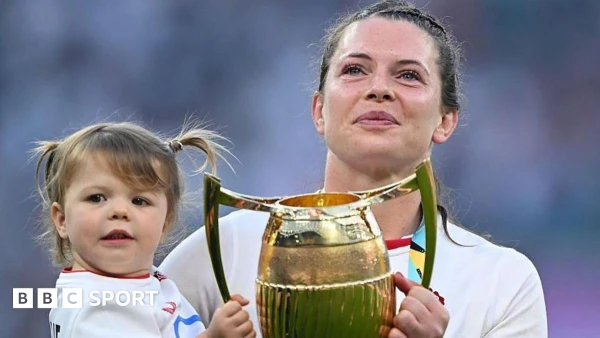
The image of Abbie Ward celebrating England's Women's Rugby World Cup victory while holding both the trophy and her daughter Hallie has become a powerful symbol of change in women's sports. That moment, witnessed by teammate Lark Atkin-Davis, represents a seismic shift in how professional athletes approach motherhood.
Ward, a 33-year-old lock, made history as the first contracted England woman to have a baby since the Red Roses turned professional in 2019. Her remarkable return to international rugby just 17 weeks after giving birth—followed by starting and scoring in the 2025 World Cup final—has inspired a new generation of athletes to believe they don't have to choose between family and career.
"Seeing Abbie go through her pregnancy with Hallie was the turning point," Atkin-Davis revealed. "I always had this desire to be a mum, but I didn't know what it would look like. Seeing her on the pitch after the World Cup final showed me it was possible."
Inspired by Ward's journey, Atkin-Davis announced her own pregnancy in December 2025 and is due to give birth this summer. They're part of a growing cohort of England players embracing motherhood while maintaining elite athletic careers, including captain Zoe Stratford and fellow World Cup winner Rosie Galligan.
This cultural shift is supported by the Rugby Football Union's progressive maternity policy, updated in February 2023. Players now receive 26 weeks of fully paid leave, with travel and accommodation costs covered for children of players selected within 12 months of giving birth. The policy also allows for a "support person" to accompany players at games or training camps.
Perhaps most significantly, pregnant players can remain in camp on specialized training programs, with Ward and Atkin-Davis continuing to train alongside teammates in the gym throughout their pregnancies.
Ward's pioneering journey hasn't been without challenges. After returning for the 2024 Women's Six Nations, she acknowledged feeling "judged" for playing international rugby less than a year after giving birth. Yet her success has fundamentally changed perceptions about what's possible for athlete mothers.
As these elite rugby players continue to train, compete, and prepare for motherhood simultaneously, they're not just changing the game—they're rewriting the narrative about pregnancy in professional sports entirely.