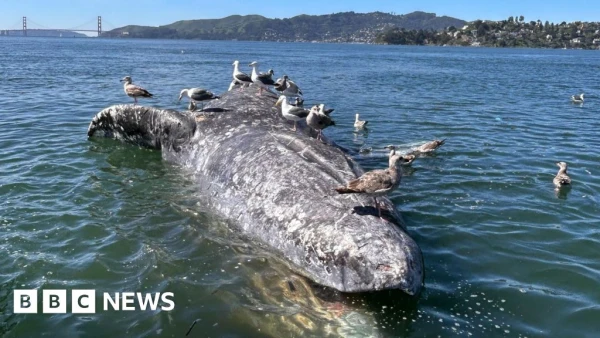
San Francisco Bay, known for its iconic bridge and bustling maritime traffic, has become an unexpected and troubling refuge for Eastern North Pacific gray whales. These massive creatures, famous for their epic 15,000-20,000 km annual migration between the Arctic and Baja California, are now appearing in the estuary in unprecedented numbers—and many are not surviving the visit.
Researchers report a disturbing trend: gray whales, visibly undernourished and thinner than normal, are entering the bay driven by hunger. Their traditional food sources in the Arctic are dwindling, likely due to climate change, leaving them without the energy reserves needed to complete their migration. "They don't have the energy reserves necessary to complete the entire migration back to the Arctic, so they may be driven into the bay by hunger," explains Josephine Slaathaug, a graduate student at Sonoma State University who led a recent study on the phenomenon.
While starvation brings them to these waters, it is often not what kills them. Slaathaug's study, published in Frontiers in Marine Science, reveals a grim statistic: nearly one-fifth of the gray whales that enter San Francisco Bay die there, primarily from collisions with ships. The bay's crowded waterways, filled with container ships, ferries, and pleasure craft, create a deadly obstacle course for the disoriented and weakened whales. A record 21 dead gray whales were documented in the broader bay area in 2025 alone.
"It's sad to see a dead whale. It's sadder to see a dead whale that you may have recognised from studying that particular whale. But there's also a lot that we can learn," said Kathi George of The Marine Mammal Center, whose team has assisted with numerous necropsies on the stranded giants.
The crisis is showing alarming new signs. Whales are appearing earlier in the season, and researchers are observing very low calf counts, indicating a troubling decline in birth rates. The overall population of these west coast gray whales has plummeted from 27,000 in 2016 to about 12,500 in 2025—a decline so severe the U.S. government has declared it an "unusual mortality event."
"It's an immediate crisis that needs to be addressed," said study co-author Moe Flannery. "This paper is just the first step in gathering the science that's needed to help inform conservation and management of this species that's in trouble."
In response, a coalition of scientists, the U.S. Coast Guard, and maritime industries is scrambling for solutions. Ferry captains are being trained to slow down and give whales space, and there are plans to install infrared cameras to monitor whale movements in high-traffic areas, especially at night. "Anything we can throw against the wall and see what sticks, we're willing to give it a try," said Gary Reed of the U.S. Coast Guard.
Despite the dire situation, scientists see a glimmer of hope. Gray whales have made remarkable recoveries before, such as after the end of commercial whaling. Their intelligence and adaptability are now being tested as they explore San Francisco Bay as a potential new foraging stop.
"If they have the protections they need in San Francisco Bay, this could be a place where they can successfully create a new foraging stopover to help them complete their migration and come back again and thrive," said wildlife veterinarian Michelle Barbieri Lino. The bay's new whale residents, therefore, represent both a critical warning about the health of our oceans and a test of our ability to protect vulnerable wildlife in an increasingly human-dominated world.