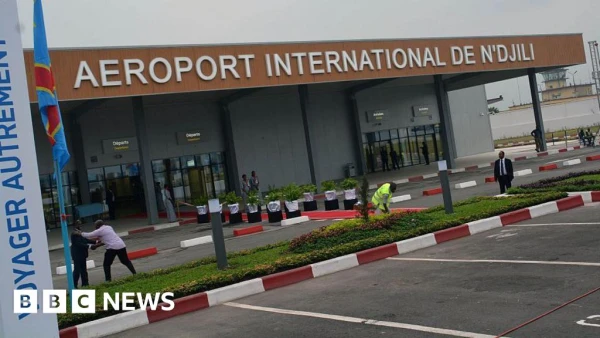
The Democratic Republic of Congo has received its first group of deportees from the United States, marking a significant development in Washington's ongoing immigration enforcement strategy. Fifteen individuals, reportedly from South American nations, arrived at N'djili International Airport in Kinshasa early Friday morning.
This initial transfer represents the first batch of an unspecified number of people that the US plans to send to the central African nation under a recent agreement. Congolese authorities have emphasized that the arrangement is temporary, with the US government funding "their reception, support and care."
A government statement clarified the terms: "The individuals concerned are admitted to the national territory under short-stay permits, in accordance with national legislation concerning the entry and residence of foreigners." An airport source revealed that the group consisted primarily of Colombian and Peruvian nationals.
"The decision to receive what are known as third-country migrants aligns with our commitment to human dignity, to protecting the rights of migrants and international solidarity," the Congolese government stated earlier this month when details of the deportation deal first emerged.
The arrangement is part of a broader US initiative that has already seen deportees sent to several other African countries including Ghana, South Sudan, and Eswatini. According to a US Senate Foreign Relations Committee report, the Trump administration has likely spent over $40 million on third-country deportations through January 2026, with more than $32 million provided directly to five nations: Equatorial Guinea, Rwanda, El Salvador, Eswatini, and Palau.
The US State Department declined to comment specifically on diplomatic communications but reaffirmed its "unwavering commitment to end illegal and mass immigration and bolster America's border security."
This deportation program coincides with ongoing US negotiations with DR Congo regarding access to the country's substantial mineral reserves, including cobalt, tantalum, lithium, and copper. The US has also facilitated peace talks between Congo and Rwanda, though implementation of agreements remains challenging.
The Congolese government has been careful to frame the deportation arrangement as temporary, stating explicitly that it "was not a permanent relocation mechanism or an outsourcing of migration policies."