I recently set off on a solo road trip from my home in Sussex to the Scottish Highlands, a journey that took me through Eryri (Snowdonia), Lancashire, the Lake District, and Yorkshire. Over 13 days and 1,600 miles, I discovered that the northern half of Britain—so often overlooked by southerners—is a land rich in history, beauty, and unexpected stories.
My first stop was Betws-y-Coed in Eryri, where the Royal Oak hotel has welcomed artists since the late 18th century. Hotel manager Katie Valentine told me how painters like JMW Turner were drawn to the dramatic Gwydir Forest and the Glyderau peaks, only to flee when the railway arrived in 1868, grumbling about overtourism—a complaint that sounds all too familiar today.
In Llandudno, I found a beach town so pristine it felt like a Victorian theme park. Trustee Judith Phillips of the Llandudno Museum explained that the Mostyn family, who built the resort in the mid-19th century, still controls everything from hotel colors to business licenses. The museum itself, run by passionate volunteers, reminded me that history often hides in small-town archives.
Driving along the North Wales Expressway, the Irish Sea stretched cobalt-blue to the horizon. Farther north, I explored early Lake District guidebooks by Thomas West and William Wordsworth at the Armitt Library in Ambleside, pored over Queen Victoria's handwritten letters (including her potato salad recipe) at Blair Castle, and listened to 90-year-old volunteer Richard Croisdale recount Wakes Week holidays in Blackpool at Blackburn Museum.
Blackburn's grand Victorian museum and Bolton's neoclassical town hall are legacies of Lancashire's industrial heyday, but no place confounded my expectations more than Blackpool. Arriving on a Friday night, the promenade blazed with lights and joy—kids skipping, coasters rattling—a stark contrast to the town's deprivation. Claire Smith, co-owner of Number One South Beach B&B, described Blackpool as "a town of extremes," where pockets of joy sit next to caverns of woe. She shared stories of 1970s boarding houses, where guests queued for bathrooms and landladies locked doors between meals. "People expected much less, but I think they were happier," she said wistfully.
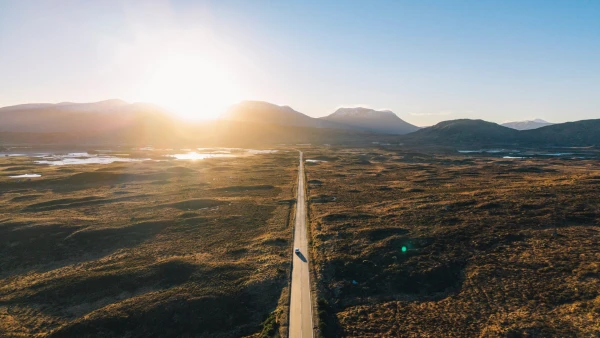
Beyond the seaside, Scotland amazed me. Following in the footsteps of William and Dorothy Wordsworth, who toured the Highlands in 1803, I drove across Rannoch Moor at dusk—a silent, pockmarked landscape that felt otherworldly. Then, the mountains of Glen Coe rose up, ominous and magnificent. At the Three Sisters viewpoint, I was relieved to see another couple; I didn't want to stand alone among those peaks.
Scotland's stories included Lord Strathcona planting spruce and redwood in Glen Coe to make his Canadian wife feel at home, and Queen Victoria's 1844 visit to Blair Castle—the first "fly-and-flop" (train-and-flop) holiday, which sparked a royal love affair with Scotland and led to the purchase of Balmoral.
When I returned home, my husband took the same photo of me perched on the car bonnet. It had been an adventure to lands unknown on the island I call home.
The Great Escape: Britain’s 400-Year Love Affair with Holidays by Annabelle Thorpe (£18.99, DK Red) is available now.