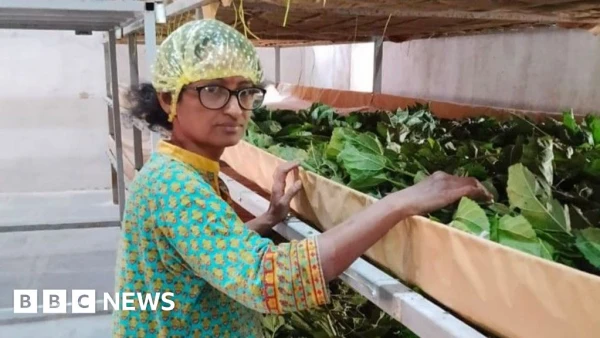
Six years ago, Dr. Jolapuram Umamaheswari left her career as a scientist in Singapore to return to India. Jobless but determined to be her own boss, she stumbled upon sericulture—the art of silk farming. "Silk farming sits at a rare intersection of biology, precision, and business," she says. "It didn't feel like I was leaving science, it felt like I was applying it differently."
Raising silkworms on her farm in Andhra Pradesh proved challenging initially. Disease outbreaks and inconsistent yields tested her resolve, but her scientific background helped her innovate. By improving hygiene, feeding practices, and environmental control, she now produces 10 crops of raw silk annually, earning around $1,000 per month. "The result is like a steady, almost salary-like income," she notes.
Modern sericulture is undergoing a digital transformation. Krishna Tomala, founder of Asho Farms, explains: "A silkworm grows nearly a thousand times in just 25 days, but its success depends on temperature, humidity, and quality leaves." Asho Farms uses sensors and AI to monitor conditions and detect diseases with over 99% accuracy. India, the world's second-largest silk producer, offers four commercial varieties—Mulberry, Tasar, Eri, and Muga—the last unique to the country.
Looking ahead, the Central Silk Board is exploring genome editing to create disease-resistant silkworms and utilizing by-products like dried pupae, rich in protein, for animal feed. However, reeler Satheesh Kannur worries about declining farmer interest and fragmented landholdings. The Silk Board counters that modern techniques have boosted yield per acre, making sericulture more viable.
Back on her farm, Umamaheswari plans a low-tech addition: a cow shed for milk and manure to fertilize mulberry plants. "Even small improvements in technique can significantly increase yield and quality," she says, proving that blending tradition with innovation can weave a sustainable future.