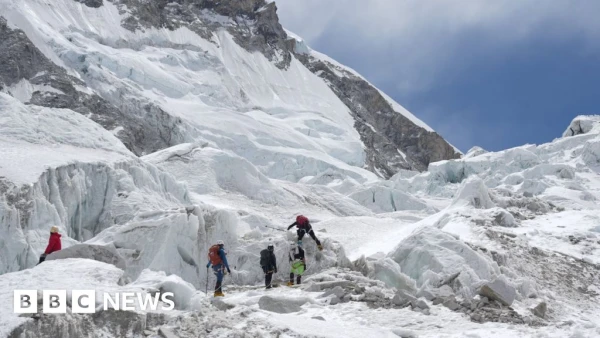
A massive, unstable chunk of glacier is blocking the path up Mount Everest from Base Camp in Nepal, just as the spring climbing season reaches its peak. Known as a serac, the 100-foot-high (30-meter) block of ice sits just below Camp 1, and icefall doctors—who fix ropes and ladders on the lower portion of the route—have been unable to find a way around it.
The only solution, they say, is to wait for the ice to melt naturally, which they hope will happen within days. But the delay has pushed preparations weeks behind schedule, raising concerns that climbers will face queues again this year as they rush to summit before favorable weather ends in late May.
Purnima Shrestha, a renowned Nepali climber and photographer currently acclimatizing for her sixth Everest summit, told the BBC from Base Camp, "We usually climb between Camp 1, Camp 2, and Camp 3 back and forth during acclimatization. Delays in opening the route have added concerns of possible traffic jams to the peak this year."
The icefall doctors, working for the Sagarmatha Pollution Control Committee (SPCC), reached Base Camp three weeks ago. Normally by mid-April, they would have fixed the route as far as Camp 3, but the serac—about 600 meters below Camp 1—has halted progress.
"We haven't found artificial ways to melt it so far, so we don't have any options other than to wait for it melting and crumbling itself," said Tshering Tenzing Sherpa, SPCC base camp coordinator.
Ang Sarki Sherpa, an experienced icefall doctor, noted that the serac's lower part is weak and melting. "We reached it on 10 April. The crevasse below is melting," he said, adding that subsequent Sherpas reported further melting, bringing it close to collapse. He and other climbers have not found a safe bypass, and scaling the serac is considered too risky.
Nepal's Department of Tourism is exploring alternatives, including airlifting teams to Camp 2. Director General Ram Krishna Lamichhane stated, "We are thinking about airlifting the rope-fixing team and their logistics to Camp 2 by helicopter, so they can open the route above that altitude for now. We will wait for the ice to melt at the obstruction and work there when it's safe."
Sherpas hope that once the ice melts, rope-fixing to Camp 2 could be completed within days, and the summit route opened within a week. But Shrestha warned that even a swift opening may mean a shorter climbing window, forcing many climbers to attempt the summit in a compressed period. She noted that in 2024, she summited Everest three times in one season, with her first push on 11 May.
Despite geopolitical tensions—including the Iran war affecting fuel and travel costs—large numbers of climbers are expected this year. Dambar Parajuli, president of the Expedition Operators' Association, said, "There has been a slight decrease due to flight impacts, but mountaineering has not been as affected as trekking."
According to the Department of Tourism, 367 people have obtained permits so far, most of them Chinese. China has not issued permits for foreign nationals from its territory this year. Most Everest ascents originate from Nepal rather than the easier Tibetan route. Last year, over 700 people, including guides, summited from the Nepalese side, compared to about 100 from China.
Since viral photos of climbers queuing on Everest in 2019, Nepal has tightened its permit system and raised prices. Spring climbing fees for foreign nationals have risen to $15,000 from $11,000, and for Nepalis, they have doubled to $1,000.