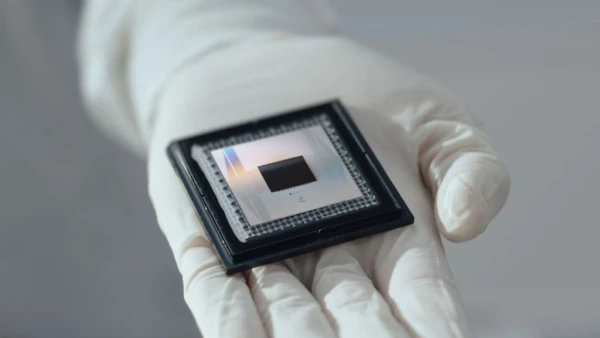
Scientists from King's College London have become the first UK academic research team to gain access to Google's cutting-edge quantum computer chip, Willow, through a partnership with the UK's national quantum lab.
Quantum computers theoretically can solve problems that the most powerful conventional computers cannot. Google claims Willow can complete a theoretical problem in five minutes that would take today's fastest supercomputers 10 septillion years.
Dr. Eleanor Crane, who will co-lead the King's research team alongside Dr. Alexander Schuckert from ENS Paris, said Willow would "light a torch" for investigating fundamental natural processes. "It would be useful if society could understand how plants transform sunlight into energy, find materials which transport electricity quickly, or how molecules bind to each other," she explained.
These processes rely on interactions among fundamental particles, but some questions are extremely difficult to answer with current computers. "If we could get to grips with these processes, then we could use this understanding to create better solar cells, more efficient energy grid systems, and discover drugs for previously untreatable diseases," Crane added.
Quantum mechanics, which governs particle behavior, underpins quantum computers and makes them particularly suited for such problems. Google says Willow incorporates key breakthroughs and "paves the way to a useful, large-scale quantum computer." Crane noted that significant developments are occurring across the UK, Europe, US, China, and elsewhere, with quantum computers "quickly progressing towards useful tasks for society."
The King's team will use Willow to develop techniques needed for quantum computers to model natural systems like photosynthesis.
Charina Chou, chief operating officer of Google Quantum, said King's had "made a compelling research proposal." Dr. Michael Cuthbert, Director of the National Quantum Computing Centre, stated the initiative reflects the UK's commitment to world-class quantum research.
This development follows Cambridge University's recent announcement of its largest corporate partnership with American quantum firm IonQ to host what is expected to be the UK's most powerful quantum computer.
Quantum computers will not replace existing machines, as they are unsuited for many tasks. However, if they meet expectations, they promise solutions to currently intractable problems. Earlier this year, Sir Peter Knight, Chair of the National Quantum Technology Programmes Strategy Advisory Board, told the BBC Willow broke new ground, opening the door for machines of real practical value.
Google faces strong competition from rivals like IBM. Current projects must overcome significant technical hurdles to scale experimental devices into commercially viable machines. Not all applications are positive; quantum machines may eventually break encryption protecting cryptocurrency and private messages, prompting some tech and finance companies to already fortify their systems.