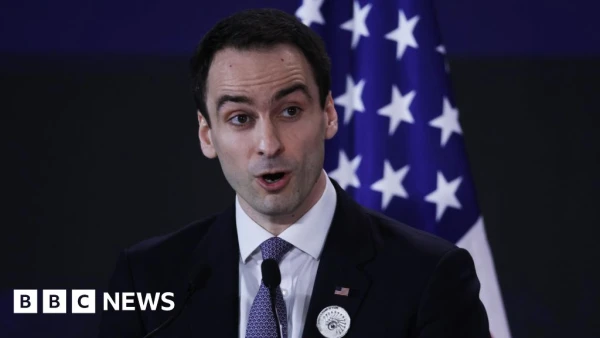
The White House has issued a memo accusing Chinese firms of engaging in mass-scale theft of American artificial intelligence (AI) technology, a practice it described as 'industrial-scale campaigns' to undermine US research and development.
Michael Kratsios, Director of the White House Office of Science and Technology Policy, wrote in an internal memorandum that 'foreign entities, principally based in China' are exploiting US companies through a technique known as 'distilling.' This involves running thousands of fake user accounts against AI chatbots or tools to trick them into revealing proprietary information, which is then used to train rival AI models.
'These actors systematically undermine American research and development and access proprietary information,' Kratsios said.
To counteract the threat, the White House outlined a four-pronged approach: sharing more intelligence with US AI firms about the tactics and actors involved, better coordinating defensive efforts, developing best practices to identify and stop distillation attacks, and exploring ways to hold foreign actors accountable.
The memo did not specify concrete actions, and a White House spokesperson declined to elaborate beyond the document.
China's embassy in Washington responded sharply. A representative said the accusations were 'unjustified suppression of Chinese companies' and argued that 'China's development is the result of its own dedication and effort as well as international cooperation that delivers mutual benefits.' The representative added that China is 'becoming the world's innovation lab.'
Distillation campaigns allow foreign entities to appear as normal users while coordinating attempts to 'jailbreak' AI models and extract non-public information. Kratsios warned that entities relying on such stolen data should have 'little confidence in the integrity and reliability of the models they produce.'