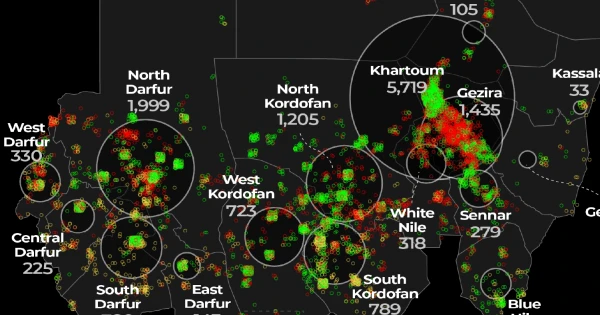
As Sudan’s devastating civil war grinds through its fourth year, the sprawling Kordofan region has morphed into a primary theater of combat. Wedged between the army-controlled central territories and the Rapid Support Forces (RSF) stronghold of Darfur, Kordofan serves as a vital strategic corridor. Recently, the Sudanese Armed Forces (SAF) have managed to reclaim significant swathes of North Kordofan, but the violence shows no signs of abating.
Modern warfare tactics, particularly drone strikes, have increasingly defined the battle for this central territory. Civilian infrastructure is bearing the brunt of these frequent aerial bombardments. The human toll was laid bare in September 2026 when a drone ripped the roof off a college in the city of el-Obeid, killing a staff member and shattering the campus.
"As you can see, the entire faculty is destroyed and we feel that our dreams are destroyed, our future is destroyed," said Omnia Aboul Gassim, a student whose exams were abruptly halted by the blast.
A Statistical Look at the Carnage
Since the conflict erupted in April 2023, data from the Armed Conflict Location and Event Data (ACLED) project reveals a staggering scale of violence. Of the nearly 14,650 recorded attacks nationwide up to September 2026, Kordofan accounts for roughly one in five.
While the capital region of Khartoum remains the single most battered area—enduring 39 percent of all strikes—Kordofan’s three states collectively follow closely behind, surpassing even the war-torn North Darfur. Across the country, the SAF has initiated just over half of all recorded attacks. Though the RSF temporarily outpaced the military in strike frequency between late 2024 and mid-2025, the SAF has since regained the upper hand.
The Battle for Strategic Hubs
Following the collapse of el-Fasher in October 2025, military attention pivoted sharply toward Kordofan. North Kordofan alone has absorbed the majority of the region's violence, with the commercial and administrative hub of el-Obeid becoming a fierce flashpoint. Capturing the city would provide the RSF with a direct, critical artery toward Khartoum.
In South and West Kordofan, localities like Dilling and Babnusa have also experienced highly concentrated fighting. Since the war's onset, Kordofan has witnessed over 12,300 reported fatalities, underscoring the lethal nature of the shifting frontlines.
A Deepening Displacement Crisis
The relentless violence continues to redraw the demographic map of Sudan. National internal displacement figures have fallen from a peak of 11.6 million in early 2025 to 8.6 million, largely due to millions of families returning to secured neighborhoods in Khartoum. However, Kordofan is experiencing a severe and fresh exodus.
The International Organization for Migration (IOM) reported a 65 percent surge in Kordofan displacements in a span of just four months in 2026. The agency is particularly concerned about el-Obeid, which currently shelters half a million people—including tens of thousands of previously displaced civilians—and faces the imminent threat of a full-scale invasion.
"The warning signs are impossible to ignore," warned IOM Director General Amy Pope. "Across Sudan, families are fleeing violence, losing access to water, electricity and healthcare, and now facing the added burden of destructive floods."