When Boeing acquired McDonnell Douglas in 1997 for $13.4 billion, it didn’t just merge two aerospace giants—it inherited a legacy that would quietly redefine Boeing’s aircraft for nearly 30 years. While much of the post-merger debate has focused on corporate culture clashes and the 737 MAX crises, the engineering decisions from McDonnell Douglas quietly endured, embedding themselves into Boeing’s DNA. From commercial jets to military workhorses, these five contributions from the former rival became permanent fixtures of Boeing’s portfolio, shaping everything from cockpit designs to fighter jets.
“The 717 was a direct descendant of the DC-9, sharing its T-tail configuration and rear-mounted engines—a design that first flew in 1965.” — Industry analysis of McDonnell Douglas’ aircraft lineage
The Boeing 717: A McDonnell Douglas Relic in Boeing’s Fleet
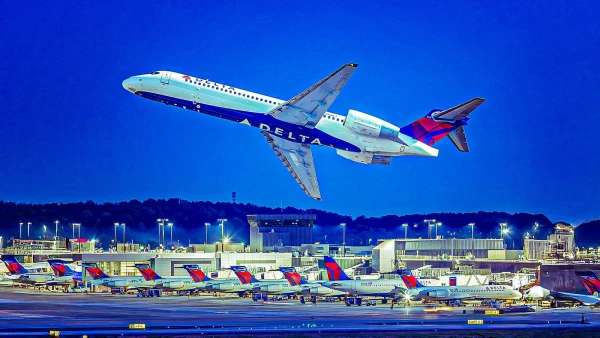
In the late 1990s, Boeing faced a dilemma. The MD-95, a 100-seat regional jet developed by McDonnell Douglas, was nearing completion—but it competed directly with Boeing’s own 737-600. After initially considering canceling the program, Boeing made a surprising choice: it rebranded the MD-95 as the Boeing 717-200 and continued production. The first delivery went to AirTran Airways in 1999, marking the only time a McDonnell Douglas commercial aircraft entered production under Boeing’s name.
Built at the former Douglas plant in Long Beach, California, the 717 found a niche with airlines operating high-frequency short-haul routes. Delta Air Lines became its largest operator, acquiring 88 aircraft after Southwest inherited them from AirTran. Though Boeing ended production in 2006 due to limited demand, the 717’s legacy endured. As of 2026, Delta continues to fly the aircraft on domestic routes, making it a rare McDonnell Douglas design that Boeing carried forward into the modern era.
Military Muscle: How McDonnell Douglas’ Fighter Jets Became Boeing’s Defense Backbone
McDonnell Douglas wasn’t just a commercial aviation player—it was a titan in military aerospace, and Boeing inherited its most valuable assets. The F/A-18 Hornet, developed for the U.S. Navy in the 1970s, became the foundation for Boeing’s F/A-18E/F Super Hornet. Entering service in 1999, the Super Hornet remains the Navy’s primary carrier-based strike fighter, with over 600 delivered and counting. Its electronic warfare variant, the EA-18G Growler, is another direct descendant of the McDonnell Douglas lineage.
The F-15 Eagle followed a similar path. Originally designed as an air superiority fighter in the 1970s, McDonnell Douglas later developed the F-15E Strike Eagle for ground attack. Under Boeing, the program evolved further, producing the F-15EX Eagle II—a new-build variant ordered by the U.S. Air Force in 2020. With updated avionics and weapons capacity, the F-15EX retains the same basic airframe designed nearly 50 years ago, making it one of the longest-running military aircraft production programs in history.
Then there’s the C-17 Globemaster III. Produced at the Long Beach facility until 2015, the final C-17 rolled off the assembly line after 279 aircraft were delivered. Boeing maintained the program for 18 years post-merger, ensuring the C-17 became a cornerstone of its defense revenue—a legacy that continues to generate billions annually.
The MD-11’s Cockpit Revolution: Automation That Paved the Way for Modern Flight Decks
The MD-11, which entered service in 1990, wasn’t just another widebody jet—it was a cockpit revolution. Classified alongside the Boeing 747-400 and Airbus A320 family as a second-generation glass cockpit, the MD-11 replaced mechanical gauges with six large CRT displays and reduced the crew from three to two pilots. Its flight management system handled everything from vertical and lateral navigation to fuel predictions, routing commands to the autopilot and autothrottle through an integrated architecture that minimized pilot workload on long-haul flights.
But the MD-11’s automation went further. It centralized system management more aggressively than most contemporaries, automating fuel transfer, center of gravity management, and even longitudinal stability through an automated tailplane trim system. While some of these features contributed to handling quirks that marred the aircraft’s reputation, the underlying philosophy—centralized, automated control—became a blueprint for later Boeing cockpits. The lessons from the MD-11’s flight deck can still be seen in modern Boeing aircraft today.