In the heart of South Africa’s Cederberg, where the Milky Way unfurls like a luminous river against the velvet night, a screen-free sanctuary is rewriting the rules of modern retreat. Bliss & Stars, a secluded lodge perched above the Doring River, has become a haven for those seeking to unplug—not just from technology, but from the relentless hum of daily life.
The journey begins with the drive itself: a winding, vertiginous route through private wilderness, where the last flicker of cell service vanishes long before the first stars emerge. For Elsa Young, who chronicled her stay in Condé Nast Traveler, the absence of signal was initially unsettling. But as the valley swallowed the last traces of daylight, something unexpected happened. Without the distraction of screens, her gaze lifted to the sky—and stayed there.
"The eye needs 20 minutes of true darkness to adjust, and a single glance at a bright screen undoes it all. Without a signal, I had no reason to look down. It was just a camera."
The retreat, Orion’s Odyssey, is timed to coincide with the new moon, when the sky is at its darkest. Guided by Heine Rasmussen, an astronomy and nature expert, and his wife Daria, a meditation teacher, guests are invited to explore the cosmos not just with their eyes, but with their breath and bodies. Under a sky so dense with stars it feels like a living thing, Rasmussen leads "mental space walks," guiding participants through meditations that stretch the imagination to the edges of time and space.
"Moonlight reaches us a second after leaving the moon," Rasmussen explains. "Sunlight takes eight minutes. The Magellanic Clouds, those pale patches in the southern sky, sent their light 160,000 years ago—when humanity was still young and rooted in Africa." The lesson is clear: the universe is not just a backdrop, but a mirror. The iron in our blood and the calcium in our bones, he tells them, were forged in stars that exploded before our sun existed.
By day, the retreat’s rhythm shifts to breathwork and yoga, led by Daria. Her sessions are less about transcendence and more about grounding—making space for the weight of daily life to shrink in comparison to the vastness above. For Young, the experience was revelatory. "From hysterical laughter to sobs of grief," she writes, "more surfaced for our small circle than any of us had bargained for."
Meals at Bliss & Stars are a study in mindful indulgence. With caffeine, sugar, meat, and alcohol off the table, the focus is on nourishment that feeds body and soul. Daria’s cookbook, Eat, Thrive, Repeat, rejects the guilt of clean-eating dogma, instead framing appetite as "information rather than judgment." Breakfasts feature ancient grain salads and beetroot flapjacks, while dinners are plant-based feasts designed to align with the retreat’s philosophy.
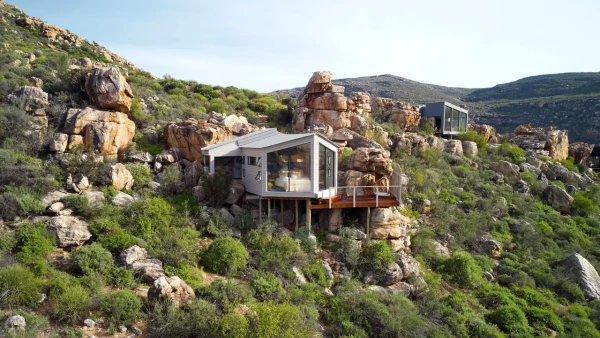
The landscape itself is a character in the story. The Cederberg’s sandstone boulders, sculpted by wind and water over millennia, rise like giant, irregular building blocks. Hikes lead to hidden river pools where the water, even at summer’s end, remains shockingly cool. Along the way, guests encounter San rock paintings—some dating back 5,000 years—silent witnesses to generations who once stood in the same silence, under the same stars.
For Rasmussen, the retreat is more than a getaway; it’s a mission. After leaving corporate life in Copenhagen in 2018, he and Daria searched the globe for the darkest skies. They found them here, in a 3,300-acre private reserve they’ve painstakingly transformed from untouched wilderness into a sanctuary for no more than 10 guests at a time. Everything—from the access road to the chalets wedged between boulders—was carried in by hand.
The result is a place where time slows, where the weight of the world feels lighter, and where the night sky becomes a classroom, a therapist, and a reminder of our place in the universe. As Young puts it, the retreat doesn’t just rewire the nervous system—it reminds us what it means to be human in a world that’s forgotten how to look up.