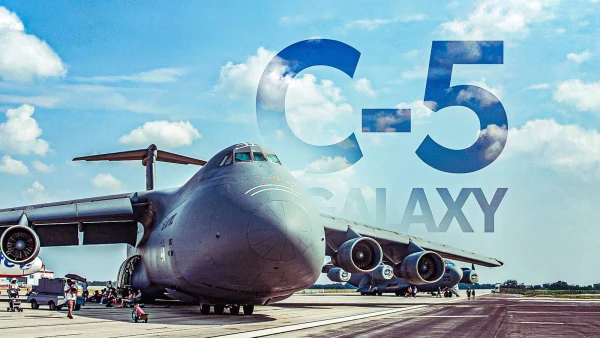
The United States Air Force has quietly extended the operational lifespan of its Lockheed C-5M Super Galaxy fleet by five years, pushing retirement to Fiscal Year 2050—a decision that underscores the enduring strategic value of the world’s largest military transport aircraft.
Despite persistent reliability challenges, with only 37% of the 52 active Super Galaxies deemed mission-capable in Fiscal Year 2025, the Air Force’s Fiscal Year 2027 budget request reflects a calculated bet on the aircraft’s unmatched heavy-lift capabilities. The C-5M remains the third-largest operational aircraft in the world, surpassed only by the now-destroyed Antonov An-225 and its smaller sibling, the An-124.
"The C-5 has seen extensive use in every major global contingency since the Southeast Asia War," the U.S. Air Force stated in official documentation. "Its ability to rapidly deploy combat forces and outsized cargo to any point on Earth remains unmatched by any other platform in the fleet."
A Legacy of Heavy Lift
The C-5 Galaxy’s origins trace back to 1961, when the Air Force sought a jet-powered replacement for the piston-engine Douglas C-133 Cargomasters. The project, initially dubbed the 'Heavy Logistics System,' attracted proposals from Boeing, Douglas, General Dynamics, Lockheed, and Martin Marietta. Lockheed’s design, powered by General Electric’s groundbreaking TF39 high-bypass turbofan engines—the first of their kind—ultimately won the contract.
The aircraft’s sheer scale has made it a cornerstone of global military logistics. With a maximum takeoff weight of 840,000 pounds and the ability to carry payloads up to 281,001 pounds, the C-5M can transport entire helicopters, tanks, or even other aircraft across continents without refueling. Its unrefueled range extends to 4,800 nautical miles with 120,000 pounds of cargo, or a staggering 7,000 nautical miles with no cargo at all.
The Fleet Today: Numbers and Fates
Of the 131 C-5 Galaxies built between 1970 and 1989, just 52 remain active—all upgraded to the C-5M Super Galaxy standard. The majority were originally delivered as C-5B models, with a handful converted from earlier C-5A airframes. The remaining aircraft are scattered across various fates:
- 37 stored in long-term preservation
- 1 preserved in a museum or static display
- 15+ scrapped after reaching the end of their serviceable life
- 6 written off due to accidents or catastrophic failures
The Air Force’s 'boneyard' in Arizona—a sprawling graveyard of retired military aircraft—houses many of these stored Galaxies. While some are maintained in a state of readiness (Type 1000 storage), others have been cannibalized for parts (Type 2000) or stripped for scrap (Type 4000). The exact classification of each aircraft remains unclear, but the service insists that the most viable airframes are kept in a state of near-immediate readiness.
The Future: Replacement on the Horizon
The Air Force’s decision to retain the C-5M until 2050 buys time for its Next-Generation Airlift (NGAL) program, which is slated to introduce a successor aircraft around 2038. Each NGAL platform is expected to replace one C-5M, though the Air Force has hinted that a single aircraft could eventually supplant both the C-5M and the smaller C-17 Globemaster III.
"The NGAL program represents a generational leap in strategic airlift," said a senior Air Force official. "But until that aircraft arrives, the C-5M remains the backbone of our heavy-lift operations."
No Plans to Revive Production
Production of the C-5 Galaxy ended in 1989, and despite its continued relevance, there are no serious discussions about restarting the assembly line. The Air Force has instead focused on extending the service life of existing airframes through upgrades and meticulous maintenance.
While Boeing—now the successor to McDonnell Douglas—has explored the possibility of restarting C-17 production for export markets, the Super Galaxy’s unique capabilities mean it will likely remain the world’s premier heavy-lift transport for decades to come.
For aviation enthusiasts and military strategists alike, the C-5M’s extended tenure is a testament to Lockheed’s engineering prowess and the Air Force’s adaptability in the face of evolving global challenges.